TL;DR
- Ambient lighting sets the base level with coves, downlights, panels and chandeliers spread evenly across the room.
- Task lighting puts brighter light where you work, such as 300 to 500 lux for reading, against 100 to 200 lux for a living room in general.
- Accent lighting is about contrast: a feature needs at least three times the surrounding brightness to stand out.
- Beam angle separates the layers, from wide 60° downlights for ambient light to narrow 24° spots for accents.
- A lighting plan shows each fixture, its switching and a fixture schedule on the reflected ceiling plan.
- Gulf villas and majlis rooms favour warm 2,700 to 3,000 K layered light, with coves and chandeliers.
What Are the 3 Layers of Lighting?
| Layer | Purpose | Typical fixtures | Beam | How bright | Control |
|---|---|---|---|---|---|
| Ambient | See and move safely; set the mood | Cove, recessed downlights, panels, chandeliers | Wide, e.g. 60° | Base level: 100–200 lux in a living room | Main switch, often dimmed |
| Task | Light for reading, cooking, grooming, work | Under-cabinet, reading, desk and vanity lights | Directed at the work surface | Higher: 300–500 lux for reading | Local switch at the task |
| Accent | Draw the eye to art, texture or display | Spotlights, wall washers, picture and profile lights | Narrow, e.g. 24° | At least 3× the surrounding level | Own circuit or dimmer |
Lux values: NBC 2016 Part 8, Section 1, Table 1. Accent ratio: Lighting Design Lab. Beam angles: example datasheets cited below.
Plan Lighting in the Same Model as the Ceiling
Augmintech's BIM Architecture program teaches building information modelling for architecture, where ceilings, fixtures and reflected ceiling plans come out of one model and stay coordinated. See the course page for the current syllabus, schedule and fees.
Ambient Lighting
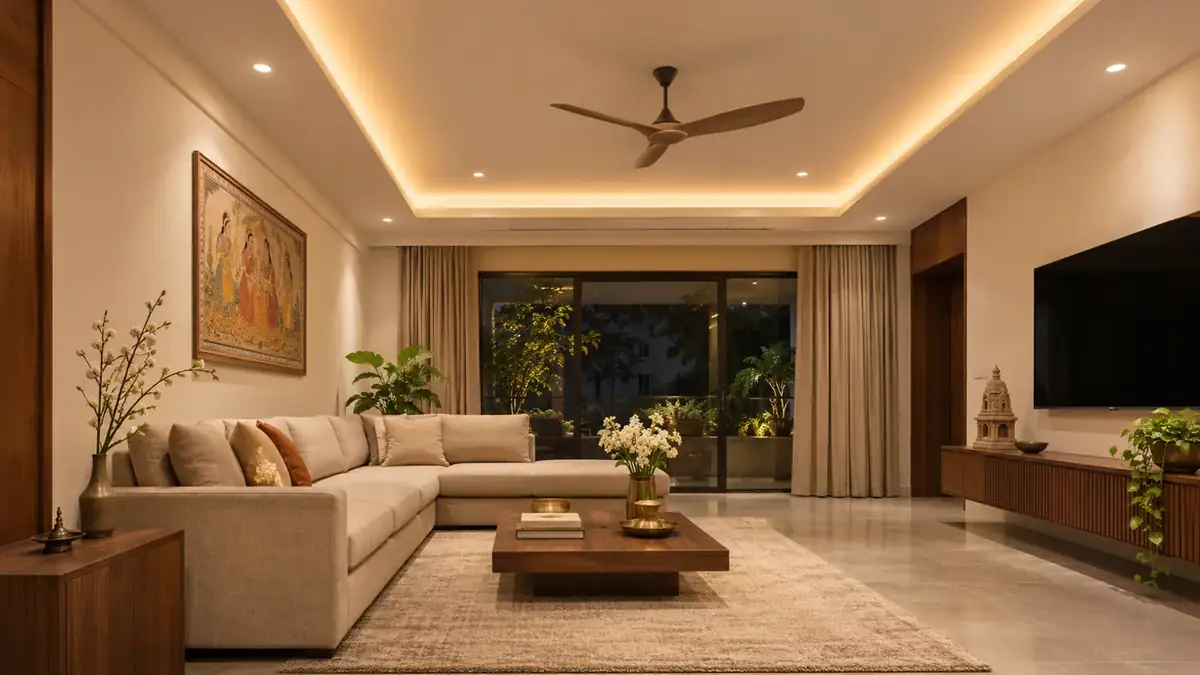
Ambient lighting replaces daylight after dark. Its job is to light the room evenly, without dark corners or hard shadows, so the space reads clearly at a glance. Crompton's guide calls it simply "the general illumination of a space".
Even light comes from layout, not wattage: a regular grid of fittings, beams that overlap at working height, and light bounced off pale ceilings and walls. A typical ambient downlight has a wide beam. For example, SAL's Coolum Plus is:
Task Lighting
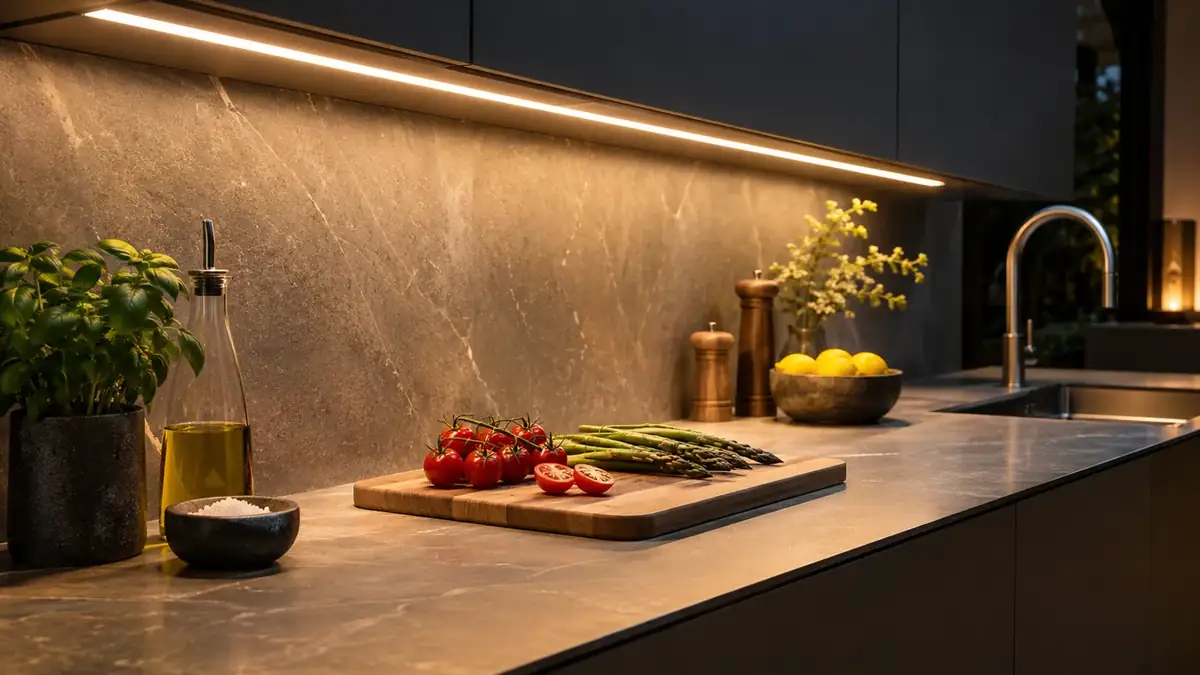
Task lighting is brighter, more focused light where a specific job happens. It is there because ambient light alone is not enough for detail work. India's National Building Code (NBC 2016, Part 8) recommends 100 to 200 lux in a living room in general, but 300 to 500 lux for reading, provided locally, and 300 to 500 lux on a kitchen counter.
Accent Lighting
Accent lighting draws the eye to something: a painting, a textured stone wall, a niche, a plant. It works through contrast. If the accent is barely brighter than the room, nobody notices it. Lighting Design Lab's guidance gives these ratios of accent to ambient light:
Accent fittings use narrow beams to put light only where it is wanted. Integral's AccentPro downlight, for example, is:

One Room, 3 Layers
Here is the same living room three ways. Use the buttons to add each layer.

AI-generated lighting comparison. Use the controls to compare the layers; these illustrations are not a photometric simulation. Click any image to enlarge.


Lighting by Room and How to Draw a Lighting Plan
| Room | Ambient | Task | Accent | General lux (NBC) |
|---|---|---|---|---|
| Living room | Cove, downlights, pendant | Reading floor or table lamps | Spots on art, profiles in niches | 100–200 |
| Bedroom | Dimmable cove or downlights | Bedside reading lamps | Headboard wall wash or profile | 75–150 |
| Kitchen | Downlights or panels | Under-cabinet LED over the counter | Glass-cabinet or plinth profiles | 300–500 (counter) |
| Bathroom | Moisture-rated downlights (e.g. IP44) | Vanity lights beside the mirror | Niche profile in the shower | Not quoted |
| Office | LED panels in the grid | Desk lamps | Wall wash on a feature or brand wall | 300–500 (desk) |
Lux: NBC 2016 Part 8, Section 1, Table 1, via Infralens. Bedroom reading 300–500 lux locally. We did not find a bathroom value in the sources checked, so none is given.
A lighting plan is drawn on the reflected ceiling plan (RCP). It shows every fitting as a symbol, the switching that groups fittings into circuits, and a schedule that defines each fitting type. Here is a sample for a 6.0 × 4.5 m living room:
| Type | Fixture | Example specification | Qty | Switch |
|---|---|---|---|---|
| A | Recessed downlight (ambient) | 9 W, 60° beam, CRI >90, dimmable, IP44, 92 mm cut-out (SAL Coolum Plus) | 7 | S1 |
| B | Adjustable spot (accent) | 25 W, 1,725 lm, 24° beam, CRI 90, 3,000 K, 120 mm cut-out (Integral AccentPro) | 2 | S2 |
| C | LED strip in profile, in cove (ambient) | 3,000 K warm white, the colour Jaquar suggests for living areas; length 15.6 m (cove perimeter) | 1 run | D1 |
| D | Pendant or chandelier | To interior designer's selection | 1 | S3 |
| E | Switched socket for floor lamp (task) | At reading chair | 1 | Local |
To draw it in AutoCAD:
- Start from the RCP: walls, ceiling levels and cove lines on their own layers, such as A-CLNG.
- Insert fixture blocks on a lighting layer such as E-LITE, one block per fitting type, tagged A, B, C.
- Draw switching as curved dashed lines (arcs) from each switch to the fittings it controls, on E-LITE-SWCH.
- Add the switch plate at the door, labelling switches (S1, S2…) and dimmers (D1).
- Attach the fixture schedule and a legend, so every tag points to a wattage, beam angle, colour temperature and quantity.
Lighting in Gulf villas and majlis rooms
- Warm colour temperature. Algedra's Abu Dhabi majlis guide (November 2025) recommends about 2,700 to 3,000 K for a welcoming feel.
- Layered light. The same guide says layered, warm lighting is widely used in Abu Dhabi villas, with coves, wall sconces and floor lamps as secondary layers.
- Chandeliers as the centrepiece. Large crystal chandeliers give the room presence and scatter reflections across marble floors.
- Put coves on dimmers. Majlis rooms host everything from formal visits to late evenings, so wire cove and chandelier circuits for dimming and scenes.

Frequently Asked Questions
Sources
- NBC 2016 Part 8, Section 1, Table 1, via Infralens: living room, bedroom, kitchen, office.
- Lighting Design Lab, accent lighting contrast ratios.
- Crompton, What is ambient lighting.
- SAL, Coolum Plus LED downlight specification; Integral LED, AccentPro 24° downlight.
- Jaquar UAE, Profile light design ideas (11 March 2026).
- Algedra, Majlis styling design in Abu Dhabi (20 November 2025).
This article was last reviewed on 7 November 2026.
