BIM's Role in Sustainable Building Design and Green Certifications
December 12, 2025
12:48 am
2000+
Comments
Facebook
LinkedIn
WhatsApp
Table of Contents
Sustainable design is no longer a luxury. It is a necessity. As the global construction industry moves toward net-zero goals and climate resilience, Building Information Modeling (BIM) has become a core enabler of green buildings and sustainability-focused development.
From reducing material waste to enhancing energy efficiency, BIM is helping architects, engineers, and sustainability consultants make smarter, data-driven decisions at every stage of the building lifecycle.
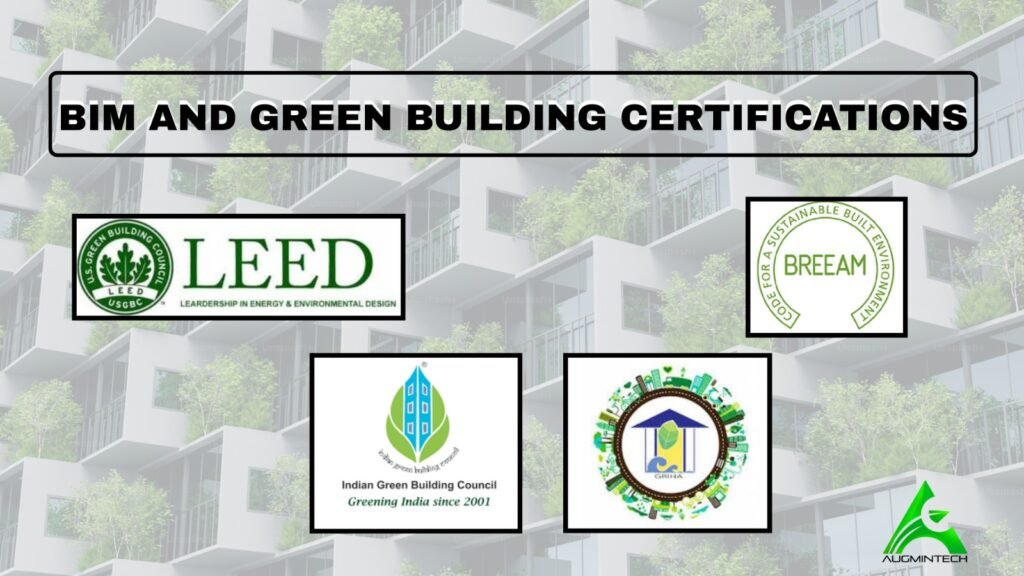
In this article, we explore how BIM contributes to sustainable building design and how it supports popular green certification systems like LEED, BREEAM, IGBC, and GRIHA.
Augmintech BIM Community - Click to join.
What is Sustainable Building Design?
Sustainable building design focuses on minimizing the environmental impact of buildings by optimizing energy performance, water use, indoor air quality, material selection, and long-term operations.
Goals include:
Lower carbon emissions
Reduced energy and water consumption
Minimal construction waste
Use of eco-friendly materials
Healthier indoor environments
How BIM Supports Sustainability Goals
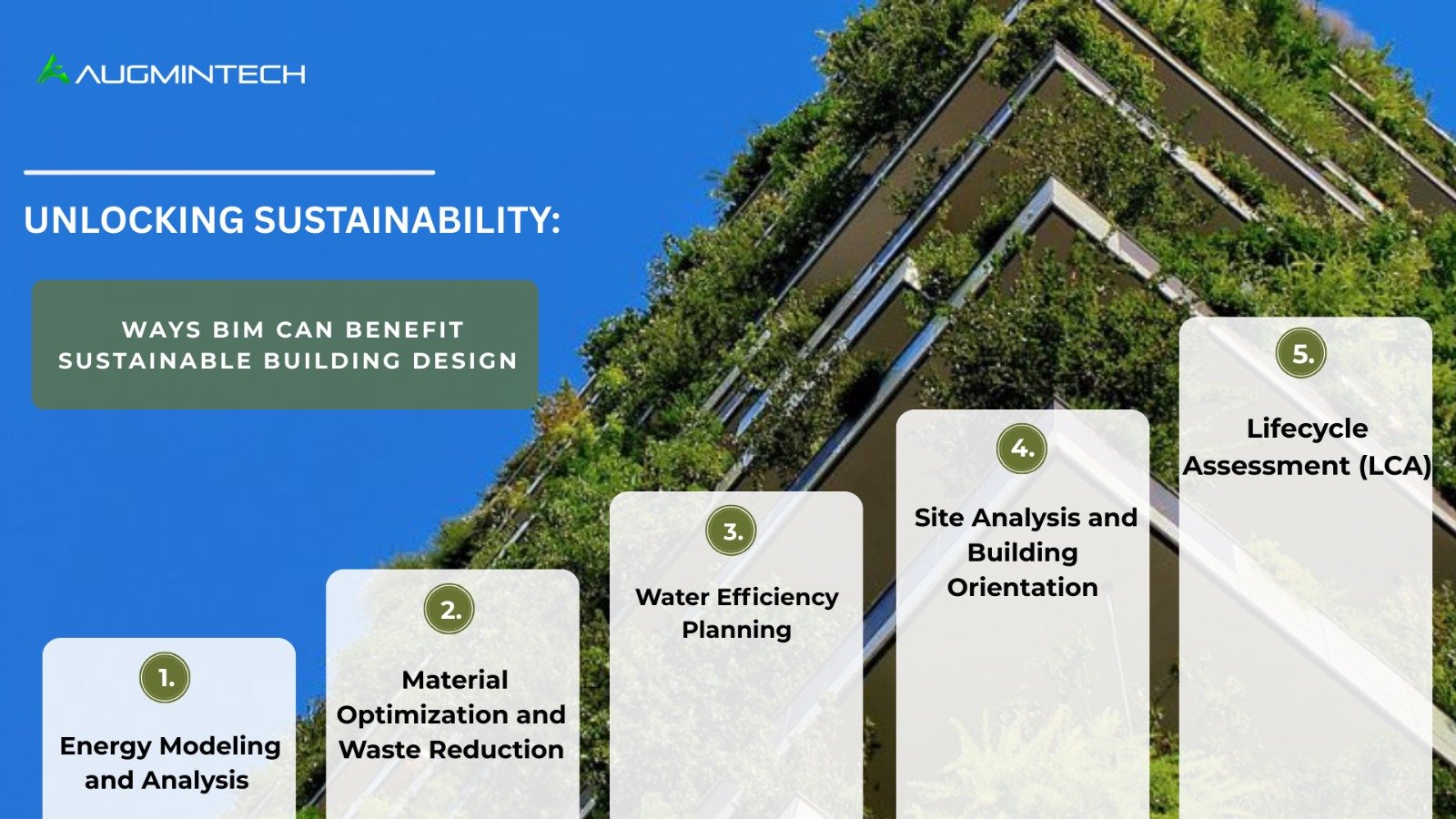
1. Energy Modeling and Analysis
BIM integrates with energy simulation tools like Insight 360, Green Building Studio, and IES VE to analyze energy consumption early in design.
You can simulate HVAC loads, solar exposure, daylighting, and optimize passive design strategies.
2. Material Optimization and Waste Reduction
With BIM’s accurate quantity takeoff, designers can estimate material requirements precisely, reducing over-ordering and waste.
It also helps track the use of recycled or locally sourced materials, which are essential in green rating systems.
You can simulate HVAC loads, solar exposure, daylighting, and optimize passive design strategies.
3. Water Efficiency Planning
Plumbing systems modeled in BIM allow planners to analyze water use, detect inefficiencies, and design for rainwater harvesting or greywater reuse.
4. Site Analysis and Building Orientation
Using BIM with GIS or tools like Autodesk InfraWorks, teams can evaluate terrain, climate, and orientation to optimize building performance.
5. Lifecycle Assessment (LCA)
BIM enables Lifecycle Assessment (LCA) workflows by integrating data on material carbon impact, operational energy, and long-term maintenance.
BIM and Green Building Certifications
1. LEED (Leadership in Energy and Environmental Design)
BIM helps gather documentation for LEED credits like Energy Optimization (EA), Water Use Reduction (WE), and Material Resources (MR).
Automates reporting on areas, materials, and system efficiencies.
2. BREEAM (UK and Europe)
BIM supports lifecycle cost analysis and sustainability performance modeling needed for BREEAM scoring.
3. IGBC (India Green Building Council)
BIM-based energy modeling and water conservation design contribute directly to IGBC credits.
4. GRIHA (India)
GRIHA emphasizes passive design, material sustainability, and thermal comfort. BIM tools help in modeling and evaluating all these aspects.
Case Example: BIM for LEED Gold Office Tower in Bengaluru
Project: 15-storey commercial office building
Sustainability Goals: LEED Gold, 30 percent energy savings, rainwater harvesting
BIM Workflow:
Revit and Insight 360 used for early energy simulation
BIM 360 coordinated HVAC and lighting systems
Accurate quantity takeoff ensured optimal material usage
LEED documentation extracted directly from BIM data
Result: Achieved LEED Gold with 28 percent reduced energy use and 40 percent less water consumption
Tools That Connect BIM and Sustainability
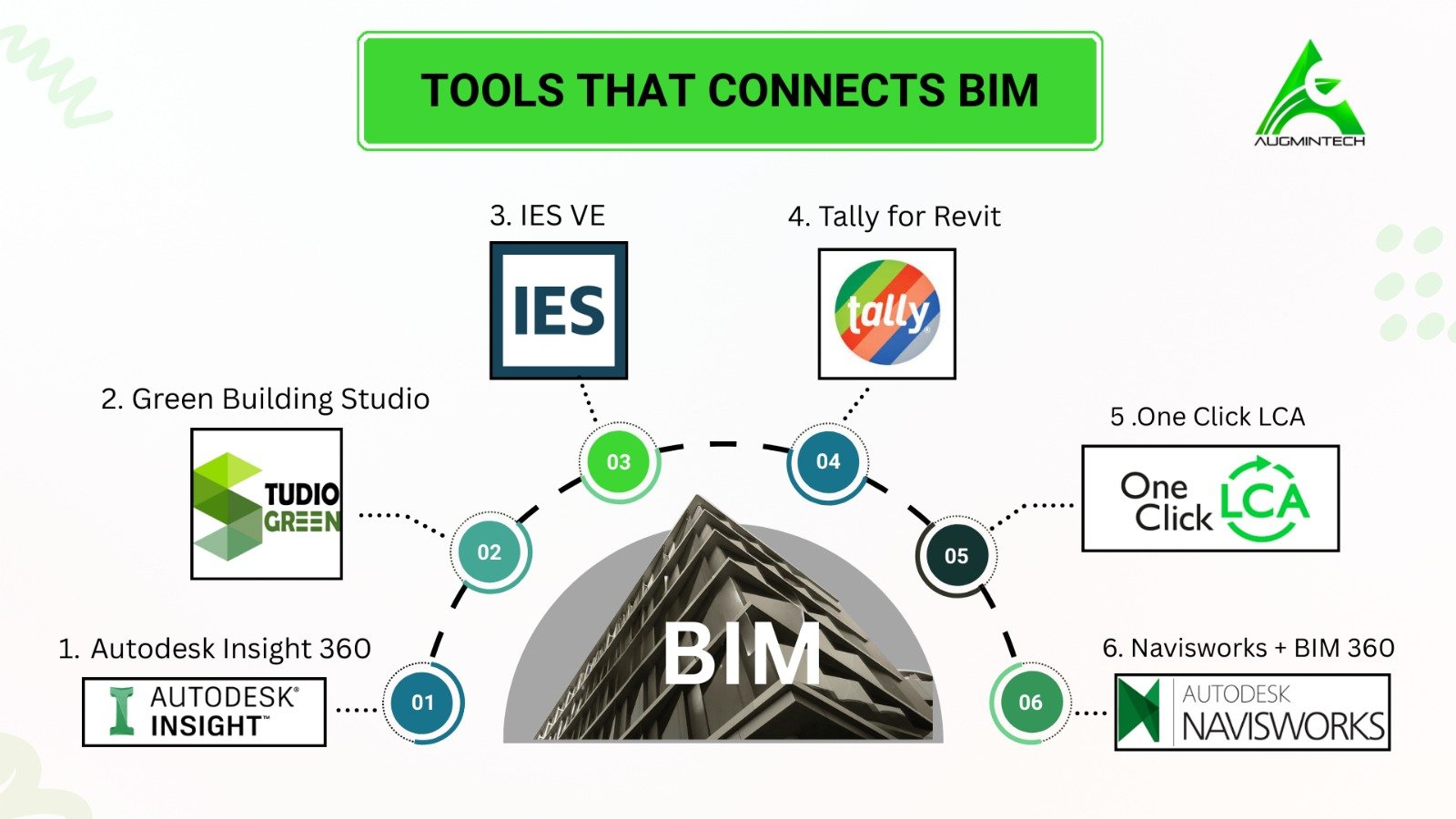
Autodesk Insight 360: Energy and solar analysis
Green Building Studio: Web-based performance simulation
IES VE: Detailed energy modeling for HVAC
Tally for Revit: Lifecycle Assessment tool for embodied carbon
One Click LCA: Streamlined carbon and LCA tracking
Navisworks + BIM 360: Coordination and model-based documentation
Skills Needed to Use BIM for Green Design
Revit modeling with energy parameters
Integration of analysis tools (Insight, GBS, IES)
Understanding of LEED, IGBC, or GRIHA requirements
If you are planning a career in sustainable architecture or MEP systems, these BIM skills will put you ahead of the curve.
Final Thoughts
BIM is no longer just about modeling buildings. It is about modeling better buildings. Sustainable buildings.
By learning how to apply BIM for sustainability and green certifications, you can play a key role in creating climate-resilient cities, smarter infrastructure, and a healthier built environment.
Frequently Asked Questions (FAQ) – BIM & Sustainable Building Design
How does BIM contribute to sustainable building design?
BIM supports sustainable design by enabling energy modeling, material optimization, water use analysis, and lifecycle assessments. It helps reduce environmental impact through better design decisions and performance analysis.
Which sustainability certifications can BIM help achieve?
BIM supports green certifications like LEED, BREEAM, IGBC, and GRIHA by automating documentation, simulating building performance, and aligning with sustainability criteria for energy, water, and material efficiency.
Can BIM be used for energy efficiency modeling?
Yes, BIM integrates with tools like Insight 360, Green Building Studio, and IES VE to simulate HVAC loads, solar exposure, daylighting, and energy consumption for energy-efficient building design.
How does BIM help reduce material waste?
With BIM’s accurate quantity takeoff capabilities, material requirements can be precisely calculated, minimizing over-ordering and construction waste while promoting the use of sustainable materials.
What tools are used to combine BIM with green building practices?
Common tools include Autodesk Insight 360, Green Building Studio, IES VE, Tally for Revit, One Click LCA, and Navisworks. These tools support energy modeling, carbon tracking, and sustainability reporting.
Can BIM help in achieving LEED certification?
Yes, BIM streamlines LEED documentation by generating reports for energy modeling, water efficiency, and material tracking, contributing to key LEED credits and compliance requirements.
What are the benefits of using BIM in eco-friendly construction?
BIM improves collaboration, reduces design errors, enhances resource efficiency, and supports data-driven decisions for low-carbon, high-performance buildings—making it vital for eco-conscious construction.
Where can I learn BIM for sustainable design and green certifications?
You can enroll in the PG Programs in BIM by Augmintech, which include modules on energy modeling, LEED/IGBC workflows, lifecycle analysis, and low-carbon design techniques.
Take the Next Step in Your BIM Career
Ready to build a future in BIM for MEP, Civil, or Architecture? Our hands-on courses will equip you with the tools, projects, and certifications you need to succeed in the AEC industry.
How Building Information Modeling (BIM) is revolutionizing civil engineering! From roads and bridges to tunnels and smart cities, BIM enables engineers to plan, simulate, and manage projects with 3D accuracy, real-time collaboration, and cost-efficient workflows. Whether you’re a student or professional, this beginner-friendly guide explains what BIM is, how it’s used in civil projects, and why it’s a must-have skill in 2025. Start learning BIM today and future-proof your career!
How to Download & Install Navisworks: A Step-by-Step Guide 2026 March 1, 2026 11:27 am 900+ Comments Facebook LinkedIn WhatsApp Introduction: Are you looking to integrate Navisworks into your workflow? Navisworks is an essential tool for architects, engineers, and construction professionals for project review and 3D model simulations. In this