How to Become an MEP Design Engineer: A Roadmap for Freshers and Working Engineers

How to Become an MEP Design Engineer: A Roadmap for Freshers and Working Engineers

Facebook
LinkedIn
WhatsApp

Nobody graduates as an MEP design engineer. Indian engineering degrees rarely teach building services in any depth, so almost everyone in the field learned it after college. That is good news: the route in is open to mechanical, electrical and civil graduates and to diploma holders, and it follows a sequence you can plan.
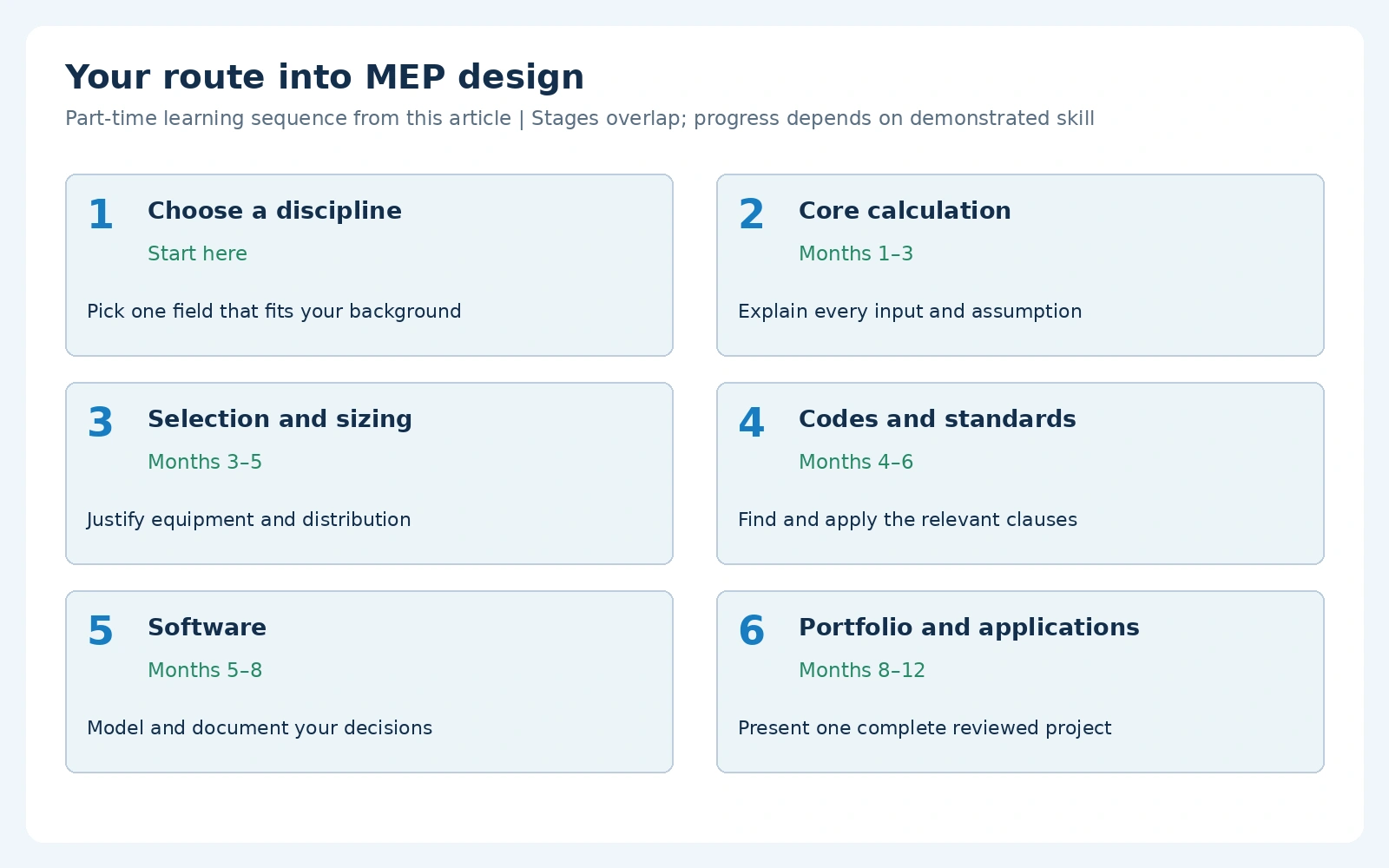
The short route: pick one discipline that matches your degree, learn its core calculation properly, then system selection and sizing, then the codes, then the software, then prove it with one complete portfolio project. Done part time, that is roughly nine to twelve months to a first design role. The order is the part people get wrong: software is fourth, not first.
The six-stage roadmap, with overlapping study periods and a clear output at each stage.

Image 1 · The six-stage roadmap, with overlapping study periods and a clear output at each stage.

Start From Where You Are

The roadmap is the same; the starting point is not. Find yours:

Path A
Fresher or final-year student
B.E., B.Tech or diploma, no industry experience. Follow the full roadmap below. Your advantage is time; your gap is that nobody has seen your work yet, so the portfolio matters most.
Path B
Engineer from another field
Manufacturing, maintenance, sales, quality or a different industry. Your fundamentals and professional habits transfer. Skip ahead where you can, and lead with what you already do well.
Path C
MEP site engineer
Already in the industry, wanting to move into design. Your route is different enough that it has its own guide on moving from MEP site engineer to design engineer; the key gap there is calculation, not exposure.

Stage 1: Choose One Discipline

Go deep in one discipline, not shallow in three. Employers hire an HVAC design engineer or an electrical design engineer, not a general MEP person, at entry level. Your degree usually points the way:

Table 1: Which discipline fits which background
Your backgroundNatural first disciplineWhy
MechanicalHVAC, then plumbing and fireThermodynamics and fluid mechanics transfer directly
ElectricalElectrical services: power, lighting, ELVLoad estimation and distribution design are core electrical skills
CivilPlumbing and public health, or BIM coordinationHydraulics and drainage carry over; coordination suits structural understanding
Diploma, any of the aboveSame as the degree, often via a drafting role firstDrafting builds drawing fluency while the calculation skills grow
Why HVAC gets most of the attention

In Indian commercial buildings, cooling is usually the largest single services system and the largest operating energy load, which is why HVAC design roles are the most common entry point and why most courses lead with it. That does not make it the right choice for an electrical graduate. Pick the discipline your degree prepared you for; you will learn faster and interview better.

Launch Your MEP Design & Drafting Career

Connect with our MEP course team on WhatsApp — get structure, duration, fees and placement support right away.

Enrol Now →

Stages 2 to 6: The Roadmap

Times assume part-time study alongside college or a job. Each stage has an output; do not move on until you have it.

Months
1 to 3
Stage 2: Learn the core calculation
The one calculation everything else in your discipline depends on.Do it by hand first. A calculation you can only produce through software is a calculation you cannot defend.
Output: one complete calculation you can explain line by line
Months
3 to 5
Stage 3: Selection and sizing
Turn the calculated load into equipment and distribution: choose a system type and justify it, select equipment from your own numbers, then size ducts, pipes or cables against velocity, pressure drop or voltage drop limits.
Output: a sized system with the reasoning written down
Months
4 to 6
Stage 4: The codes you will actually use
The National Building Code of India, ECBC for energy, ASHRAE standards used in Indian practice such as 62.1 for ventilation, and the fire requirements that affect services. The skill is finding the clause, not knowing the code exists.
Output: your Stage 3 design checked against the applicable clauses
Months
5 to 8
Stage 5: Software
AutoCAD for 2D production, Revit MEP for modelling and documentation, and a load calculation tool for your discipline. Learned now, the software represents decisions you already understand, which makes it faster to learn and easier to use well.
Output: your design modelled and documented
Months
8 to 12
Stage 6: Portfolio, then apply
One realistic building taken from calculation to coordinated drawings, with your assumptions and decisions written down. Then apply, leading with the portfolio rather than the certificate.
Output: a portfolio and your first applications
The order is the whole point

Most people start at Stage 5 because software is visible and feels like progress. They become able to draw a duct without being able to say why it is that size, and the first technical question in an interview exposes it. Starting at Stage 2 feels slower and is faster overall, because every later stage makes sense once you know what it represents.

If You Are Coming From Another Field

Engineers moving in from manufacturing, maintenance, sales or another industry are not starting from zero, and should not present themselves as if they were.

  • Maintenance and facilities engineers already understand how equipment fails, which makes them strong on selection and maintainability. Lead with that.
  • Manufacturing and process engineers usually have the thermodynamics and fluid mechanics; the gap is building-specific loads and codes, so Stages 2 and 4 matter most.
  • Sales and application engineers from HVAC equipment companies often know selection very well and calculation less well. Stage 2 is the priority.
  • Everyone switching brings professional habits a fresher does not have: deadlines, documentation, dealing with clients. Name them in interviews.

An illustrative design workstation: calculation on the left, the model it informs on the right.

Image 2 · An illustrative design workstation: calculation on the left, the model it informs on the right.

Skills Checklist

Tick what you can genuinely do today, unaided. Be strict: "I have seen it done" is not a tick. Nothing is stored or sent.

MEP Design Engineer: Readiness Checklist
0 of 18 skills
Engineering
Codes
Software
Portfolio and job readiness

Getting the First Role

Table 2: Entry routes into MEP design
RouteWhat it isGood for
Trainee design engineerJunior role in a design consultancyThe most direct route; competitive without a portfolio
Contractor design teamShop drawings and design support at an MEP contractorLearning buildability alongside design
Drafting or BIM modeller roleProducing drawings and models from others' designsA realistic stepping stone, if you keep building calculation skills
Equipment manufacturerApplication or selection engineerDeep equipment knowledge; move to design later
On the drafting route

A drafting or modelling role is a perfectly good first job and a common way in, especially for diploma holders. The risk is staying there: drafting experience does not turn into design experience on its own. If you take that route, keep doing Stage 2 and 3 work on the side, and ask to see the calculations behind the drawings you produce.

What to expect to earn

Entry pay is modest, and published figures vary widely. Salary aggregators put the average Indian MEP design engineer at roughly ₹3.1 to 3.5 lakh a year, a figure pulled down by the large number of junior roles. Pay rises with specialisation, and employer type affects it more than years served. Treat every figure, including these, as indicative, and check current listings on Naukri and Indeed for your city.

An illustrative portfolio review: explain the calculation, system choices and coordinated drawing.

Image 3 · An illustrative portfolio review: explain the calculation, system choices and coordinated drawing.

Download the Skills Checklist

The full checklist with what each skill looks like in practice, plus a free course consultation.

Get the checklist

Frequently Asked Questions

How do I become an MEP design engineer after graduation?
Choose one discipline that matches your degree, learn its core calculation by hand, then system selection and sizing, then the applicable codes, then the software, and finish with one complete portfolio project. Part time, that usually takes nine to twelve months. Then apply for trainee design roles, leading with the portfolio.
Can a diploma holder become an MEP design engineer?
Yes. Many people enter through a drafting or modelling role and build calculation skills alongside it. The important thing is not to stay in drafting: keep practising calculation and selection, and ask to see the design work behind the drawings you produce.
Which branch is best for MEP design?
Mechanical graduates usually start in HVAC, electrical graduates in electrical services, and civil graduates in plumbing and public health or BIM coordination. The best branch is the one your degree prepared you for, because the fundamentals transfer and you will progress faster.
How long does it take to become an MEP design engineer?
Roughly nine to twelve months of part-time study to reach a first design role, depending on your starting point and the hours you put in. Engineers moving from related fields can often move faster because their fundamentals transfer.
Is MEP design a good career in India?
It is a stable field with clear progression, growing cooling demand and international mobility, particularly to the Gulf. Entry pay is modest, and pay grows mainly with specialisation and employer type. It suits people who enjoy calculation and solving coordination problems more than those looking for the fastest early salary.
Do I need Revit to get an MEP design job?
Increasingly yes, as a baseline, but it does not get you hired on its own. Employers for design roles look first for whether you can calculate a load and justify a size. Learn Revit after the engineering, and use it to present decisions you already understand.

Sources and Notes

  • Glassdoor and AmbitionBox-derived salary data for MEP design engineers in India, averaging approximately ₹3.1 to 3.5 lakh a year. Indicative only; verify against current listings.
  • National Building Code of India and the Energy Conservation Building Code, Bureau of Energy Efficiency, for the code framework in Stage 4.
  • ASHRAE Standard 62.1 and the ASHRAE Handbook: Fundamentals, ASHRAE, for ventilation and load calculation methods.
About the timeline and checklist

The nine-to-twelve-month timeline assumes part-time study and will vary considerably with your background and the hours available. The checklist is a self-assessment aid, not a validated test; it orders skills the way design offices tend to weigh them, with engineering first. Neither replaces feedback from someone who does the work professionally.

Not Sure Which Path You Are On?

Book a consultation to map your background onto the roadmap.

Book a consultation

This article was last reviewed on 1 August 2026.

Ready to start your engineering career journey?

Investing in structured training is one of the best ways to set yourself apart in MEP engineering. Our Courses cover HVAC, electrical and plumbing design in depth, plus tools like HAP software — the exact skillset that sets you apart in a competitive field.

Augmintech-logo-white

This Exclusive PG Program will Skyrocket your Career!

*Limited Seats Available