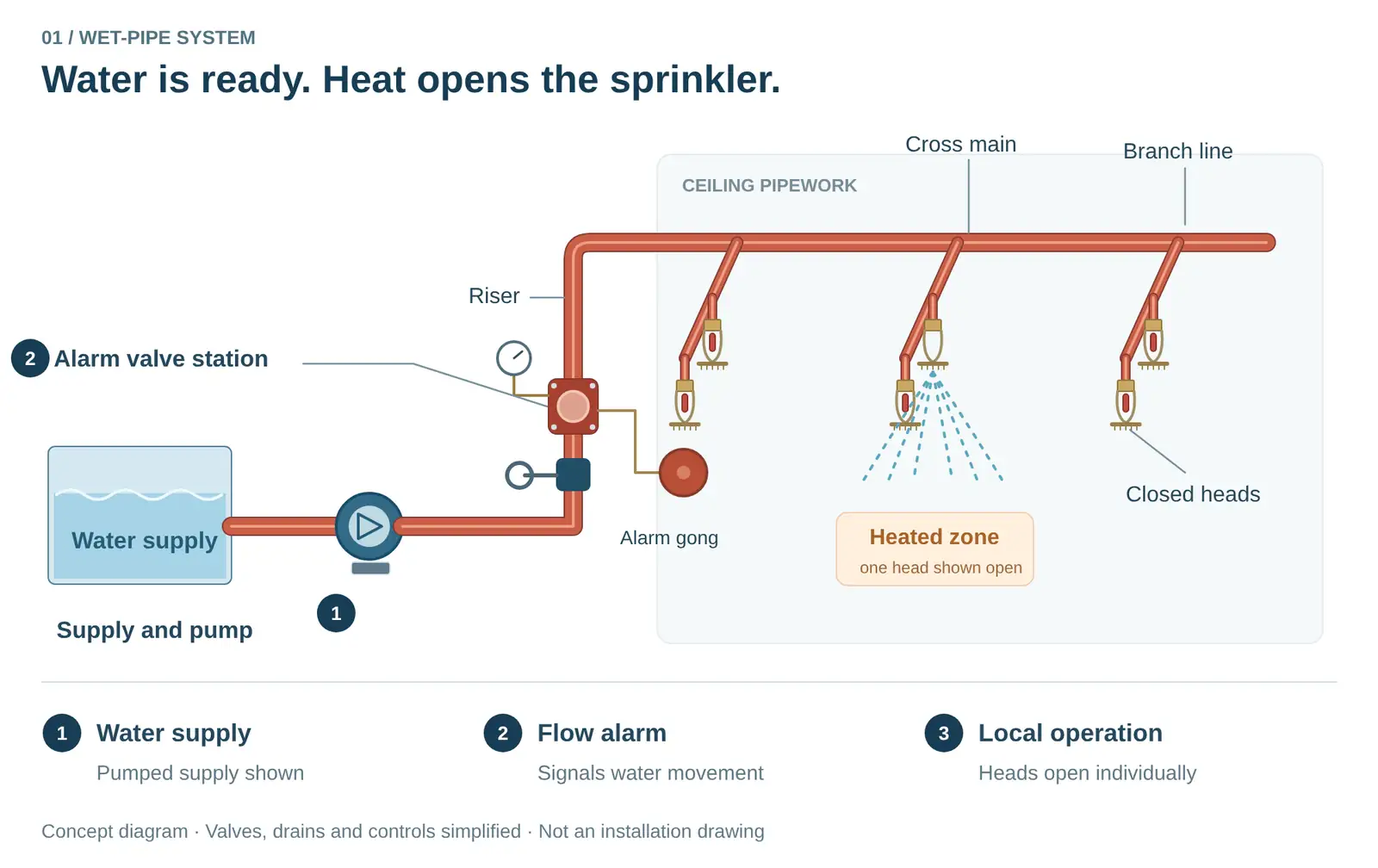
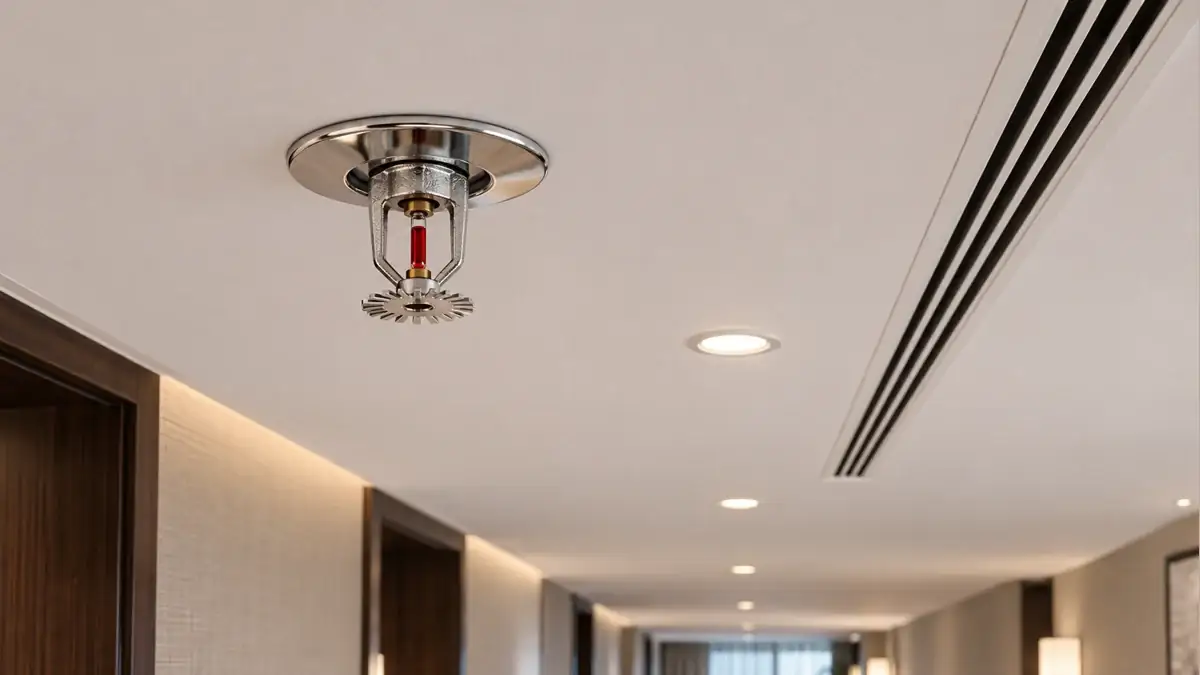
A fire sprinkler system is a network of water-filled (or air-filled) pipes with heat-sensitive sprinkler heads. Each head opens on its own when the heat at that head reaches its temperature rating, and sprays water on the fire below it.
This page compares the four system types, explains sprinkler heads and bulb colours, and summarises NFPA 13 hazard classes and coverage rules in plain words, with the Revit MEP workflow and the Indian, UAE and Saudi code picture at the end.
TL;DR
- Sprinklers open individually: only heads heated to their rating discharge, not the whole system.
- There are four system types: wet pipe, dry pipe, pre-action and deluge.
- Bulb colour shows the temperature rating: orange 57 °C and red 68 °C are the most common.
- NFPA 13 sorts occupancies into light, ordinary (groups 1 and 2) and extra hazard (groups 1 and 2).
- A standard spray head covers up to 225 ft² (20.9 m²) in light hazard and 130 ft² (12.1 m²) in ordinary hazard, at up to 15 ft (4.6 m) spacing.
- India, the UAE and Saudi Arabia all point to NFPA 13 or IS 15105 for design, with local codes deciding where sprinklers are required.
How a Fire Sprinkler System Works
- Closed heads. Each sprinkler is held shut by a liquid-filled glass bulb (or a fusible metal link).
- Heat opens one head. Hot gases from the fire heat the nearest head. When its bulb reaches its rating, it bursts and water flows onto the deflector, which spreads it in a spray pattern.
- Only nearby heads open. Heads further away stay below their rating, so they stay closed and water goes only where the heat is.
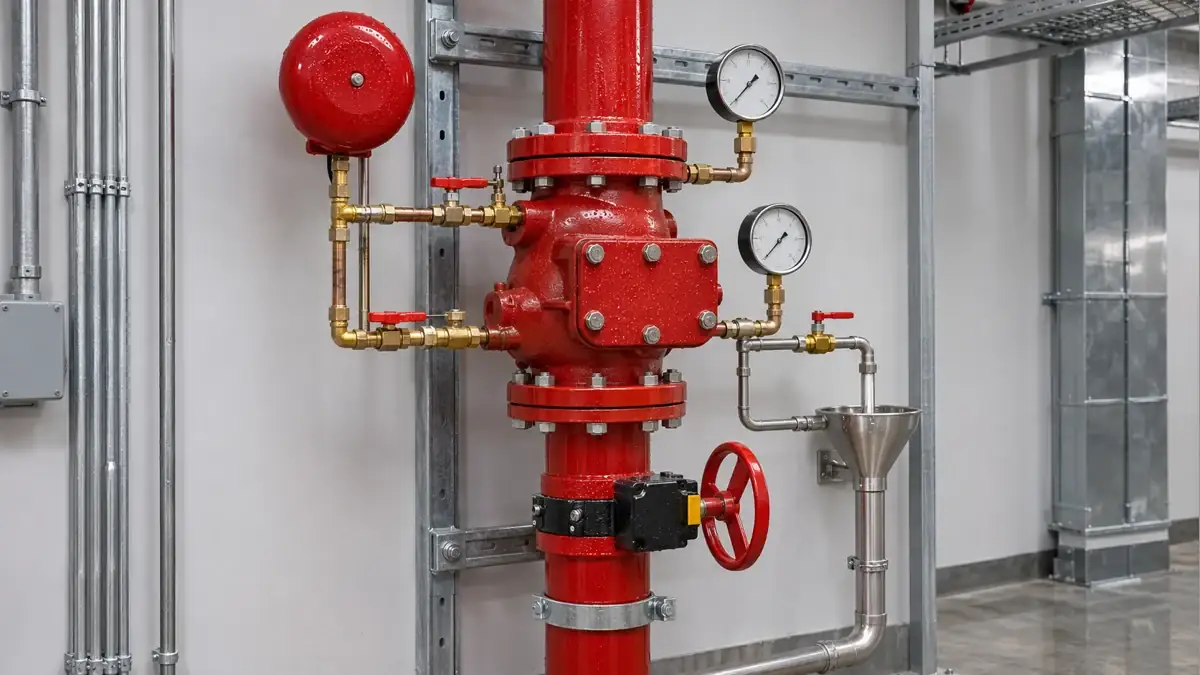
- The alarm sounds. Water flowing through the alarm valve station trips a flow switch and alarm, and the fire pump starts if pressure drops.
4 Types of Fire Sprinkler Systems
| Type | Pipe contents | How it responds | Typical use | Maintenance |
|---|---|---|---|---|
| Wet pipe | Water at all times | Fastest: water discharges as soon as a head opens | Heated buildings: offices, hotels, malls, homes | Simplest; fewest components |
| Dry pipe | Pressurised air; water held back by a dry pipe valve | A head opens, air escapes, then water fills the pipes: slower | Unheated spaces that can freeze: parking garages, cold stores, unheated warehouses | More: air supply, valve and drain checks |
| Pre-action | Air; water admitted only after a detector signals | Detection fills the pipes; a head must still open (single or double interlock) | Where accidental discharge is costly: data centres, museums, archives | Highest: detection plus valve system |
| Deluge | Empty; all heads are open | Detection opens the deluge valve and every head discharges at once | Fast-spreading hazards: flammable liquids, aircraft hangars, transformers | Detection and deluge valve testing |
Based on QRFS, which notes dry pipe systems are used where temperatures cannot be kept at or above 40 °F (4 °C).
Lay Out Sprinkler Systems in Revit MEP
Augmintech's PG Program in BIM MEP covers MEP system modelling, including fire protection, with clash detection, schedules and BOQs on three building projects, across 150+ live hours over 6 months, with recordings for 1000 days and 500+ interview questions. ₹1,50,000 + GST in India, $1,800 abroad.
Sprinkler Head Types
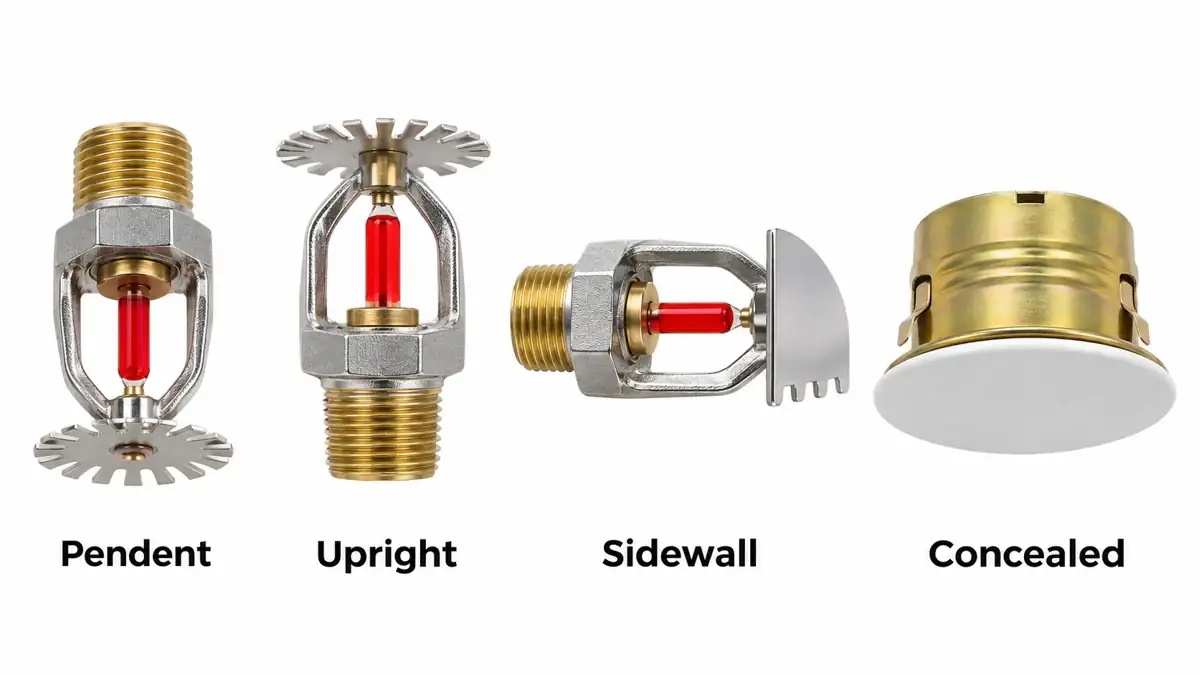
What do sprinkler bulb colours mean? The liquid colour in the bulb shows its temperature rating. NFPA 13 groups ratings into classifications:
57, 68, 79, 93 and 141 °C ratings and colours from the HD Fire sprinkler data sheet; classification ranges from an NFPA 13 study summary, which also lists black bulbs for very extra high and ultra high ratings (204 °C and above). Head types also from that summary.
Hazard Classification under NFPA 13
NFPA 13 sets the design by occupancy hazard: how much there is to burn, and how fast it burns. Typical examples:
Examples from an NFPA 13 occupancy classification summary. The designer classifies each area; one building can contain several hazard classes.
Sprinkler Coverage Area and Spacing
| Hazard | Max coverage per head | Max spacing / to wall |
|---|---|---|
| Light | 225 ft² (20.9 m²) under smooth noncombustible ceilings; less if obstructed or combustible | 15 ft (4.6 m) / 7.5 ft (2.3 m) |
| Ordinary | 130 ft² (12.1 m²) | 15 ft (4.6 m) / 7.5 ft (2.3 m) |
| Extra | 100 ft² (9.3 m²) below 0.25 gpm/ft²; 90 ft² (8.4 m²) at 0.25 or more | 12 ft (3.7 m) / 6 ft (1.8 m) |
| High-piled storage | 100 ft² (9.3 m²) | 12 ft (3.7 m) / 6 ft (1.8 m) |
Values as summarised from NFPA 13 by OpenExamPrep and cross-checked with the MeyerFire spacing chart. The current edition is NFPA 13-2025 (RiskLogic): confirm against it and the edition your authority has adopted.
In plain words: sprinklers must be at least 6 ft (1.8 m) apart so one head's spray does not cool and delay its neighbour, no further from a wall than half the maximum spacing, and at least 4 in (102 mm) from a wall. Extended coverage heads are listed for larger areas, but only within their own listing.
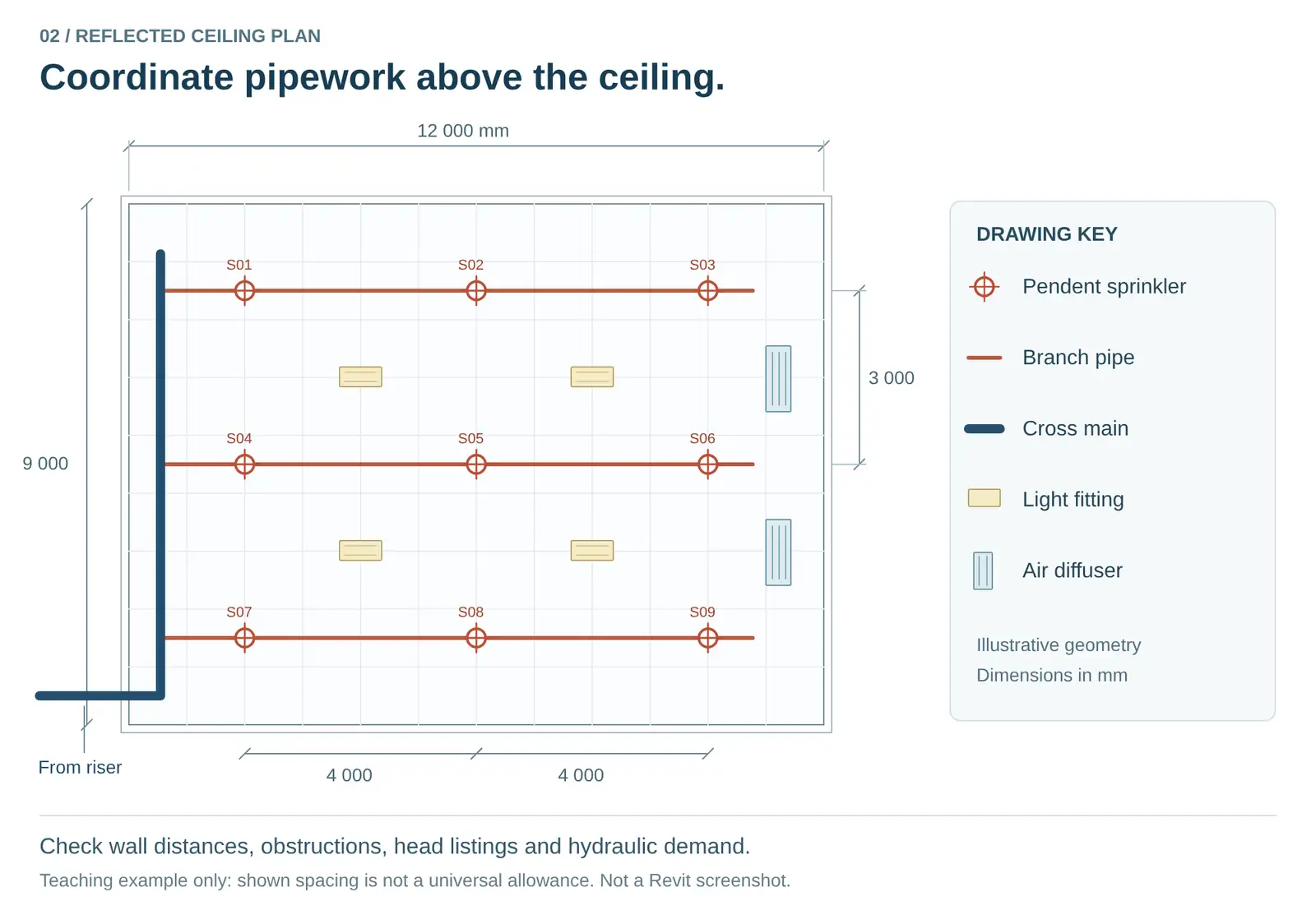
A teaching check: it takes the larger of the area-based and spacing-based counts on a simple rectangular grid. Real layouts must follow NFPA 13 rules for obstructions, ceilings and walls, plus hydraulic calculation.
Sprinkler Layout in Revit MEP
- 1. Place headsLoad sprinkler families (pendent, upright, sidewall) and place them on the ceiling or a reference plane, on a grid within the hazard's spacing limits.
- 2. Set the systemRevit has fire protection system classifications for wet, dry, pre-action and other (user-defined) systems (Revit API reference).
- 3. Pipe itRoute the riser, cross mains and branch lines, connect each head, and check that every head belongs to the right system.
- 4. Check clashesRun
Collaborate › Coordinate › Interference Checkagainst ducts, beams and cable trays; the report lists each conflicting pair and can be exported (Autodesk Help).
Coverage checking in plain Revit is visual: tag head spacing with dimensions, or use a coverage-circle family set to the maximum spacing so gaps show up on the reflected ceiling plan. Hydraulic calculations are usually done in dedicated software.
Sprinkler Requirements in India and the Gulf
India: NBC 2016 Part 4
- Table 7 sets where sprinklers are needed, by occupancy and building height
- Design and installation to IS 15105
- NBCS 2026 now published
UAE: Fire and Life Safety Code
- UAE Fire and Life Safety Code of Practice, enforced by each emirate's Civil Defence
- NFPA 13 widely used for sprinkler installation
- Annual servicing by Civil Defence-approved contractors
Saudi Arabia: SBC 801
- Section 903, Automatic Sprinkler Systems (pages 141 to 147 in the 2018 code)
- Based on the 2015 International Fire Code with NFPA standards
- Sprinklers relax other requirements, such as travel distance
India. NBC 2016 Part 4 sets sprinkler requirements in Table 7 by occupancy type and height (Table 7, Kerala Fire and Rescue Services copy). Delhi Fire Service states that sprinkler systems are designed and installed to IS 15105, with design plans and calculations submitted with the building plans (Delhi Fire Service FAQ).
UAE. Sprinkler systems are governed by the UAE Fire and Life Safety Code of Practice and enforced by each emirate's Civil Defence (Dubai, Abu Dhabi, Sharjah). NFPA 13 is widely adopted, and annual servicing must be carried out by Civil Defence-approved contractors, with test certificates sent to the authority (BITO).
Saudi Arabia. SBC 801 covers automatic sprinkler systems in Section 903 (SBC 801 contents, 2018). The code is based on the 2015 International Fire Code and NFPA standards, and a sprinklered building gains relaxations elsewhere: longer travel distances, Class I instead of Class III standpipes, and hydrant distance extended from 120 m to 180 m (Pillai, ASRJETS 2025).
Frequently Asked Questions
Sources
- NFPA 13, Standard for the Installation of Sprinkler Systems, 2025 edition; changes summarised by RiskLogic.
- OpenExamPrep NFPA 13 study guides: protection area and spacing; occupancy hazard classes; sprinkler types and temperature ratings.
- MeyerFire, sprinkler spacing chart.
- HD Fire, conventional sprinkler data sheet (temperature ratings and bulb colours).
- QRFS, Fire Sprinkler Systems: History, Types, and Uses.
- Autodesk: Revit system classifications; Interference Check.
- India: NBC 2016 Part 4 Table 7 via Kerala Fire and Rescue Services; Delhi Fire Service FAQ; NBCS 2026 via Drishti IAS and ULBA.
- UAE: BITO, sprinkler regulations. Saudi Arabia: SBC 801 (2018) contents; Pillai (2025), ASRJETS.
This article was last reviewed on 5 November 2026.
