 Revit
TL;DR
- Register with the Council of Architecture first: in India, only registered persons may use the title "Architect".
- M.Arch and M.Plan take two years and are entered through GATE, SPA's JAAP-PG or a university's own test, such as CEPT's PG Test.
- BIM and visualisation courses are short and practical, and can be done while you work.
- GRIHA CP costs ₹4,000 plus tax per attempt; LEED Green Associate costs US$250, or US$100 for students.
- Construction management at NICMAR is a two-year programme that accepts architecture graduates.
- You can combine paths: a BIM course now and an M.Arch later is a common route.
Courses After B.Arch Compared
| Option | Duration | How you get in | Cost (sourced) | Best for |
|---|---|---|---|---|
| DegreeM.Arch | 2 years (4 semesters) | GATE AR; JAAP-PG at SPAs; CEPT PG Test | Varies by institute | Specialist practice, teaching, research |
| DegreeM.Plan | 2 years | GATE; JAAP-PG; CEPT PG Test | Varies by institute | Urban and regional planning, government roles |
| DegreeMaster's in interior design | Usually 2 years | University test, e.g. CEPT PG Test | Varies | Moving into interiors |
| SkillBIM (Revit, coordination) | Weeks to months | Direct enrolment | Varies by provider | Design and BIM roles in offices |
| SkillVisualisation | Weeks | Direct enrolment | Varies by provider | Renders, walkthroughs, competitions |
| SkillComputational design | Weeks to months | Direct enrolment | Rhino student licence US$195 | Parametric and facade design |
| CredentialGRIHA CP | 75-minute exam | Graduates only, not students | ₹4,000 + tax per attempt | Green buildings in India |
| CredentialLEED Green Associate | One exam | Open registration | US$250; US$100 student | International green building work |
| ManagementNICMAR construction management programmes | 2 years | PG-NCAT, or CAT/MAT/XAT and similar | Check the current campus fee schedule | Project and construction management |
Fees are as published by the sources listed at the end, checked November 2026. Institutes revise fees every year; confirm before you apply.
Start With a Skill You Can Use Now
Augmintech's PG Program in BIM Architecture teaches building information modelling for architecture: models, coordinated drawing sets and schedules from one source. See the course page for the current syllabus, schedule and fees.
First Step: Council of Architecture Registration
Registration protects eligibility to use the title “Architect” in India. It does not replace local authority requirements for submitting or signing a particular project. Check the Council of Architecture and the relevant approving authority for your intended work.
Postgraduate Degrees: M.Arch, M.Plan and More
A master's degree is the longest path, and the right one if you want to teach, research or work in a specialised field. Specialisations on offer in 2026 include:
The list combines the M.Arch and M.Plan specialisations in SPA's JAAP-PG 2026 notification with CEPT University's 2026 master's programmes. Names differ slightly between institutes.
What each specialisation leads to
| Specialisation | What you study | Where it usually leads |
|---|---|---|
| Urban DesignM.Arch | Streets, public spaces, blocks and districts; design codes | Urban design consultancies, development authorities, smart-city projects |
| Landscape ArchitectureM.Arch | Site planning, ecology, planting, water and terrain | Landscape studios, campus and township projects, public parks |
| Architectural ConservationM.Arch | Heritage documentation, traditional materials, repair and reuse | Conservation practices, heritage bodies, restoration projects |
| Sustainable ArchitectureM.Arch | Climate-responsive design, energy, daylight, rating systems | Green building consultancies, design offices with sustainability teams |
| Urban / Regional PlanningM.Plan | Land use, master plans, planning law, infrastructure | Town planning departments, planning consultancies, policy research |
| Transport PlanningM.Plan | Mobility, traffic, transit systems, transport policy | Metro and transit agencies, transport consultancies |
| HousingM.Plan / CEPT | Housing policy, affordable housing design, neighbourhoods | Housing boards, developers, NGOs and policy work |
| Building Energy PerformanceCEPT | Energy simulation, building physics, HVAC basics, codes | Energy consultancies, sustainability and MEP-coordination roles |
Most master's programmes also lead to teaching and research. Before you choose, look at where recent graduates of that programme work; many institutes share this on their programme pages or at open days.
Three ways in
GATE is held annually. Use the official GATE 2027 syllabus and admission notices for the exact year you intend to apply; exam eligibility and a university’s admission eligibility are separate checks.
How the GATE AR paper is structured
Since GATE 2022, the Architecture and Planning paper has had three parts. Everyone answers General Aptitude and Part A; in Part B you choose either Architecture (B1) or Planning (B2), and the choice does not change how your score is ranked.
Marks out of 100. The official GATE 2027 pattern lists General Aptitude 15, common Part A 60, and the chosen Architecture or Planning section 25.
Part A carries most of the marks and covers the whole B.Arch syllabus, from history and building construction to services, planning and urban design. A practical way to prepare is to work through recent past papers early, so you see which topics come up most, and then revise those from your B.Arch notes.

Software Specialisations: BIM, Visualisation, Computational Design
Software courses are the shortest path and can run alongside a job. They do not replace a degree, but they add skills that offices use every day.
BIM. Building information modelling in Revit or Archicad: one model that produces plans, sections, schedules and sheets. On larger projects, BIM coordination with structure and MEP teams is a role in its own right. BIM is also required for permit submissions on larger buildings in Dubai.
Visualisation. Real-time rendering in Enscape, D5 or Twinmotion, plus post-production in Photoshop. Useful for competitions, client presentations and portfolio work.
Computational design. Rhino with Grasshopper for parametric form and facade panelling, or Dynamo inside Revit for rule-based tasks. A Rhino student licence costs US$195 and does not expire.
When you compare software courses, look past the software list. A good course has you complete a full project, from model to drawing set, and gives feedback on your work, because that is what you will show employers. Augmintech's PG Program in BIM Architecture is one structured option for BIM; whichever course you choose, ask to see sample student project work first.
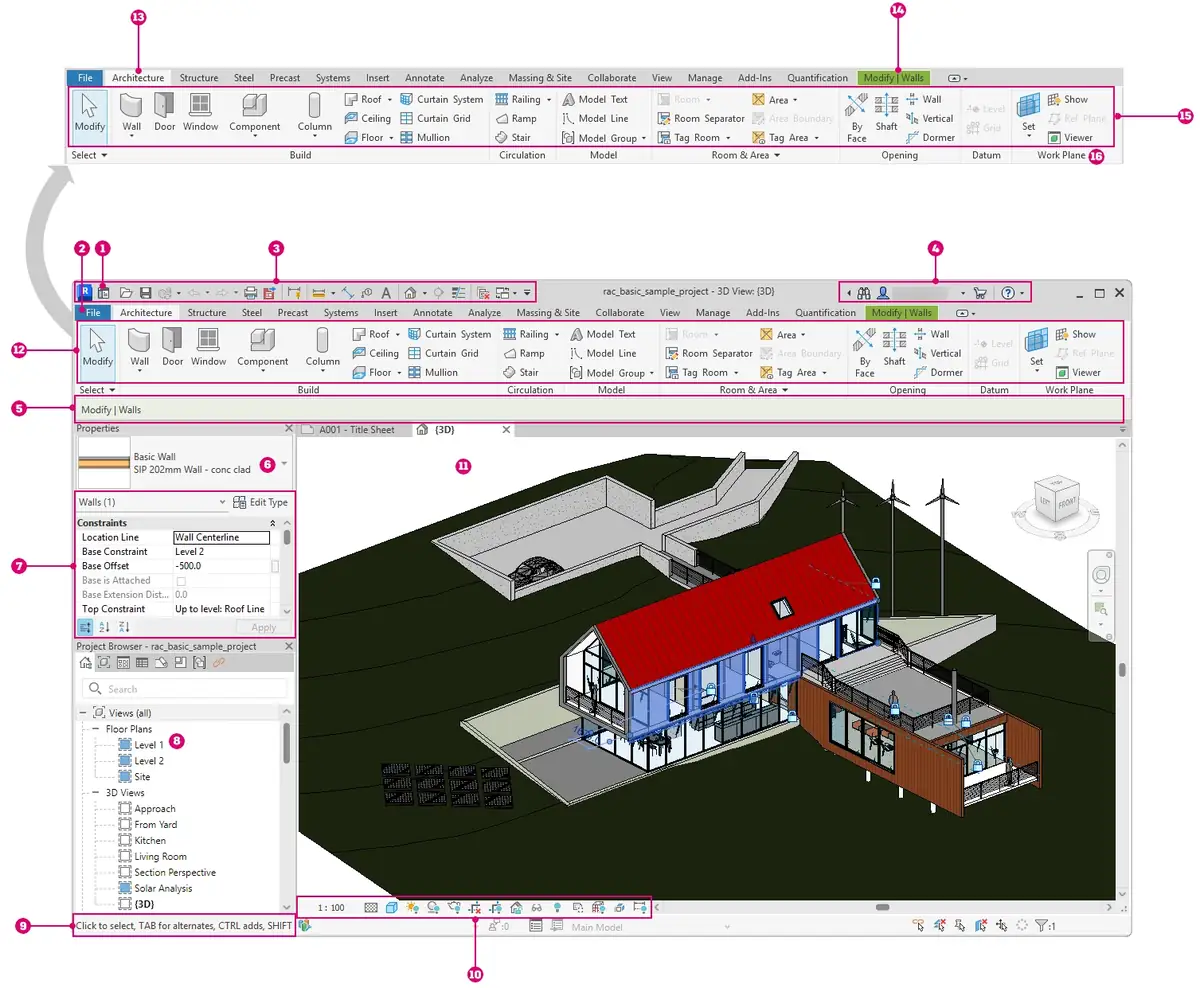
Revit interface key
- 1 Revit Home
- 2 File tab
- 3 Quick Access toolbar
- 4 InfoCenter
- 5 Options Bar
- 6 Type Selector
- 7 Properties palette
- 8 Project Browser
- 9 Status bar
- 10 View Control Bar
- 11 Drawing area
- 12 Ribbon
- 13 Ribbon tabs
- 14 Contextual tab
- 15 Active-tab tools
- 16 Ribbon panels
Start with Properties (7), Project Browser (8) and the drawing area (11). Names follow Autodesk’s example; layouts vary by release.
Sustainability Credentials: GRIHA and LEED
If you want to work in green building consulting, a credential shows you know a rating system. Both below are single exams, not full courses.
GRIHA Certified Professional
- System
- India's GRIHA rating
- Who
- Graduates and above; students not eligible
- Exam
- Online, monthly, 60 questions, 75 minutes, pass mark 75
- Fee
- ₹4,000 + tax per attempt
LEED Green Associate
- System
- USGBC's LEED rating
- Who
- Open; students may register
- Next step
- LEED AP with specialty, US$350
- Fee
- US$250; US$200 member; US$100 student
For deeper study, M.Arch in Sustainable Architecture (SPA) or a master's in Building Energy Performance (CEPT) are the degree routes.
Construction and Project Management
NICMAR’s programme titles and admission routes differ by campus. Its Pune and Hyderabad admissions pages list an MBA in Advanced Construction Management; other campuses may offer a PGDM. Compare the exact award, eligibility, entrance process, internship structure and total fee for your intake on the official admissions page. Do not rely on an older PGP fee listing. CEPT’s construction management programmes are another route to investigate.
Teaching, Research and a PhD
If you want to teach architecture, a master's degree is the usual entry requirement. For example, SPA New Delhi's recruitment rules ask an Assistant Professor of Architecture for a master's degree in architecture or a related discipline with at least 60% marks; for urban design posts, they ask for a B.Arch or B.Plan plus a master's in urban design, also with 60%. Those rules do not require a PhD at entry level, but a PhD becomes important for promotion and research roles. Other colleges follow their own and national norms, so check the advertisement for each post.
A PhD usually comes after a master's and some teaching or practice experience. Institutes such as the SPAs, IITs and CEPT run doctoral programmes; pick a supervisor whose research matches your interest before you pick the institute.
Part-time and online options
If you cannot stop working, look at part-time or weekend formats for skill courses and some postgraduate diplomas. For any degree, check that it is recognised by the relevant authority before enrolling; a certificate course can add skills, but it is not a substitute for a recognised master's degree where one is required, such as for teaching.
Studying Abroad After B.Arch
Many graduates look at master's programmes in Europe, the UK, North America or Australia. Requirements and fees vary too much to list here, but almost every application asks for the same set of things, so you can prepare them early:
Two cautions. A master's abroad does not automatically let you practise as an architect in that country; professional registration there has its own rules. And if you plan to return to India, check how the degree will be treated before you enrol.
Which Course Should You Choose?
By budget and time
| If you have… | Sourced cost | Realistic options |
|---|---|---|
| A few weeks, a small budget | ₹4,000 + tax; US$100–250 | GRIHA CP or LEED Green Associate exam; a BIM or visualisation course |
| A few months, while working | Varies by provider | BIM course plus a renderer; Rhino and Grasshopper for computational design |
| Two years, full time | Varies by institute; confirm the current campus fee schedule | M.Arch, M.Plan, a design master's or construction management |
Your Portfolio for Each Path
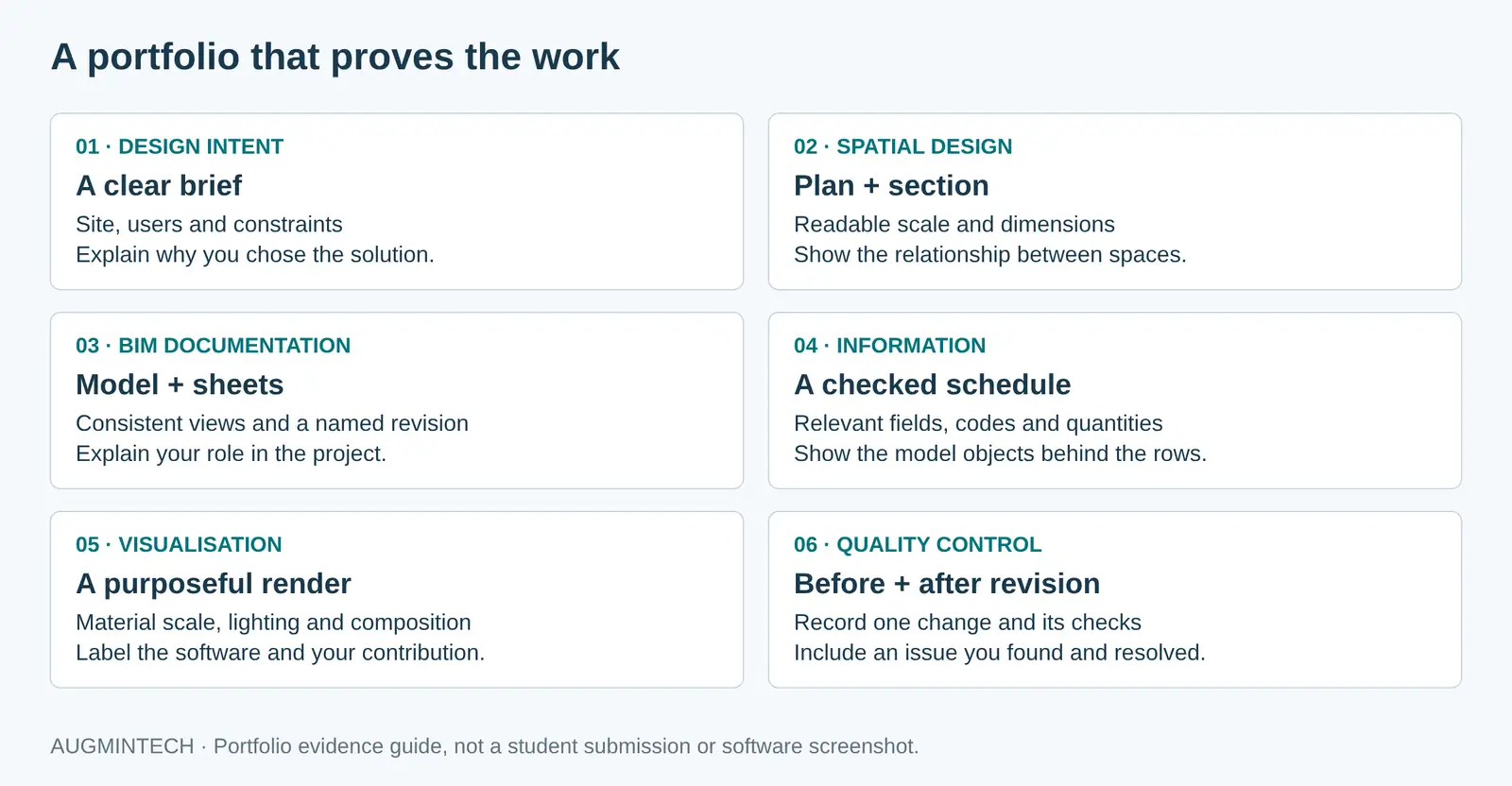
Whichever path you choose, your portfolio should point at it. The same B.Arch work can be presented in different ways.
| Path | Lead with | Also include |
|---|---|---|
| M.Arch or design master's | Your strongest design project and its thinking | Research, sketches, a project related to the specialisation |
| M.Plan | Your urban or site-level studio and thesis | Maps, analysis, data and policy reading |
| BIM roles | One project modelled in BIM with its drawing set | Schedules, sheets, a coordination view |
| Visualisation roles | Your best renders and a short walkthrough | Before-and-after post-production, lighting studies |
| Sustainability | A climate-responsive project with analysis | Daylight or energy studies, your GRIHA or LEED credential |
| Construction management | Working drawings and site experience | Internship work, any scheduling or estimating you did |
Courses After B.Arch for Gulf Careers
Many Indian architecture graduates look at Dubai, Abu Dhabi and Riyadh. Since 1 January 2024, Dubai has required BIM model submissions in IFC format for building permits on larger projects, including buildings over 20 floors or 20,000 m², as summarised on Autodesk's Dubai BIM mandate page. That makes BIM skills directly relevant. Rules for practising and signing drawings as an architect differ by country; in Saudi Arabia, for example, engineering professionals are accredited through the Saudi Council of Engineers. Check the current requirements with the relevant authority before you apply.
Not Sure Yet? Start With BIM
Whichever path you choose later, BIM is a skill many design offices ask for. Augmintech's PG Program in BIM Architecture is a structured way to add it after B.Arch. Check the course page for the current syllabus, schedule and fees.
Frequently Asked Questions
How to Evaluate a Course Before Enrolling
Ask for a sample timetable, assessment brief and anonymised student project, then compare what you would actually produce. For BIM, look for a model, coordinated sheets, schedules and a documented revision. For visualisation, look for lighting and material studies as well as final renders. For management, look for planning, estimating and reporting exercises tied to a realistic project.
- Feedback: who reviews your files, how often, and whether you can revise work after the review.
- Access: software licence terms, required computer specification, recording access and any extra exam or certification fees.
- Recognition: distinguish the training provider’s completion certificate from a university degree, professional credential or vendor certification exam.
- Career evidence: ask how placement figures are calculated, which cohort they cover and what support is actually included. A software certificate alone does not establish job readiness.
Try the Work Before Committing
Spend two weeks on a small assignment in your preferred path. A BIM candidate can model one apartment and issue two checked sheets; a visualisation candidate can make two interior lighting studies; a sustainability candidate can analyse shading and daylight assumptions; a management candidate can prepare an elementary activity schedule and quantity sheet. Use the difficulty you encounter to decide what instruction you need.
Then compare the full cost: tuition, software, equipment, examinations, travel or accommodation, and any earnings you will give up. Keep short professional courses and recognised postgraduate degrees in separate categories when comparing outcomes. Augmintech’s PG Program in BIM Architecture is one option to assess against this checklist; confirm its current syllabus, award and support directly before enrolling.
Current primary references: GATE 2027 paper pattern, LEED Green Associate, GRIHA Certified Professional and Council of Architecture: use of title.
Sources
Software logos and credited screenshots belong to their respective owners. Interface examples may differ from your installed release. Editorial diagrams and generated illustrations are labelled separately.
- CEPT University, CEPT accepts GATE 2026 scores for master's admissions (2026).
- The Aarch News, SPA releases JAAP-PG 2026 notification (2026).
- NIT Tiruchirappalli, M.Arch PG regulations.
- GATE (IIT Kharagpur), Architecture and Planning (AR): new pattern.
- SPA New Delhi, Recruitment rules: qualifications of teaching posts.
- GRIHA Council, GRIHA Certified Professional.
- ArchiRoots, The LEED exam in 2026: costs and format (updated 4 November 2026).
- Careers360, NICMAR construction management programmes.
- Free Press Journal, Council of Architecture warns against misuse of the "Architect" title (2 August 2026).
- Render a House, Rhino pricing (September 2026).
- Autodesk, Dubai Municipality BIM mandate.
- Saudi Council of Engineers, Gradual approach to professional examinations.
This article was last reviewed on 8 November 2026. Admission rules and fees change every year; check each institute's official notice before you apply.
