Pipe fittings are the components that change a line's direction, branch it, change its size or close it. This guide covers fittings for industrial process piping (refineries, plants, EPC projects), not home plumbing.
Here are all 10 fittings at a glance. Tap any one to jump to its section. You will see these names on every piping isometric and material take-off (MTO).
TL;DR
- Fittings change direction (elbows), branch (tees, crosses, olets), change size (reducers, swages) or close a line (caps).
- Butt weld fittings follow ASME B16.9 (NPS 1/2 to 48) and match the pipe schedule.
- Socket weld and threaded fittings follow ASME B16.11 (NPS 1/8 to 4) and are rated by class: 2000, 3000, 6000 or 9000.
- The line class decides the fitting type, end connection and material for each size range.
What Are Pipe Fittings?
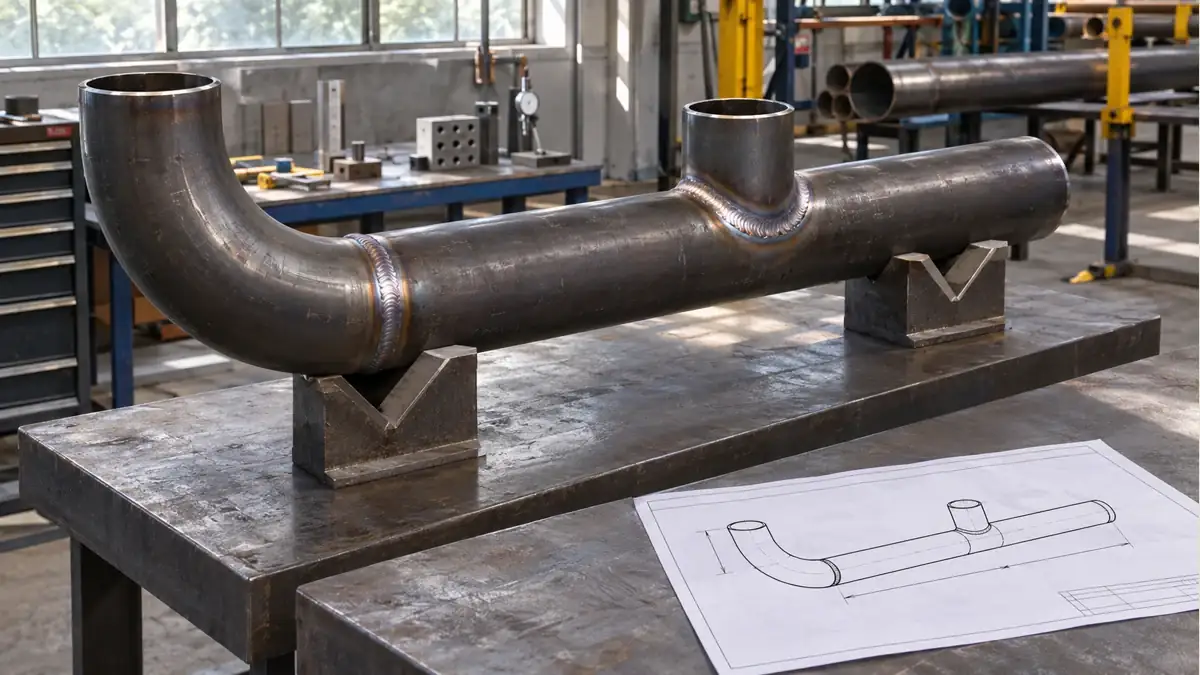
A pipe fitting is any component, other than straight pipe, flanges and valves, that joins pipe and does one of four jobs: change direction, branch the flow, change the pipe size, or close the end. On a piping isometric each fitting appears as a symbol, and on the MTO as a line item with its size, schedule or class, end type and material.
10 Types of Pipe Fittings with Names and Pictures
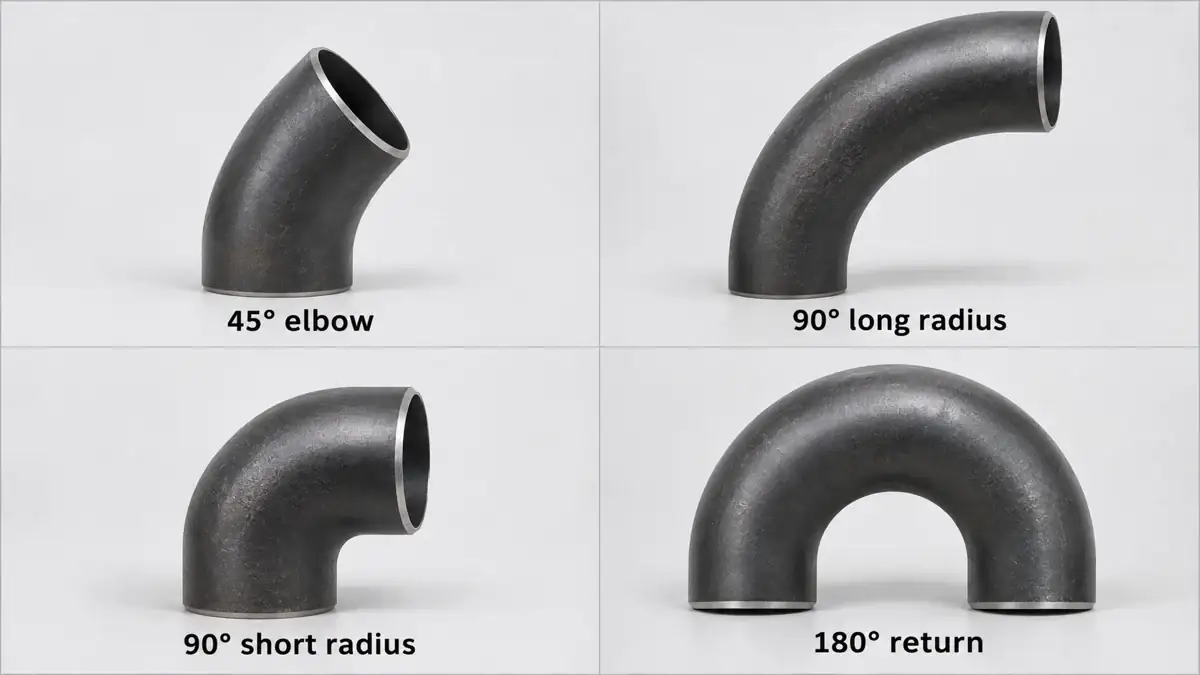
Elbows (45°, 90°, 180°; Long and Short Radius)
Elbows change direction. They come in 45°, 90° and 180° (return bend) versions, and in two radii (Project Materials):
- Long radius (1.5D) is the default. A 90° LR elbow has a resistance coefficient of about 0.25 to 0.30, with less erosion, and ASME B31.3 assumes LR unless the designer specifies otherwise.
- Short radius (1D) is used in tight spaces, where the spec calls for it, or in low-pressure utility service. Its K-factor is higher (about 0.35 to 0.45), and SR elbows can jam pipeline pigs.
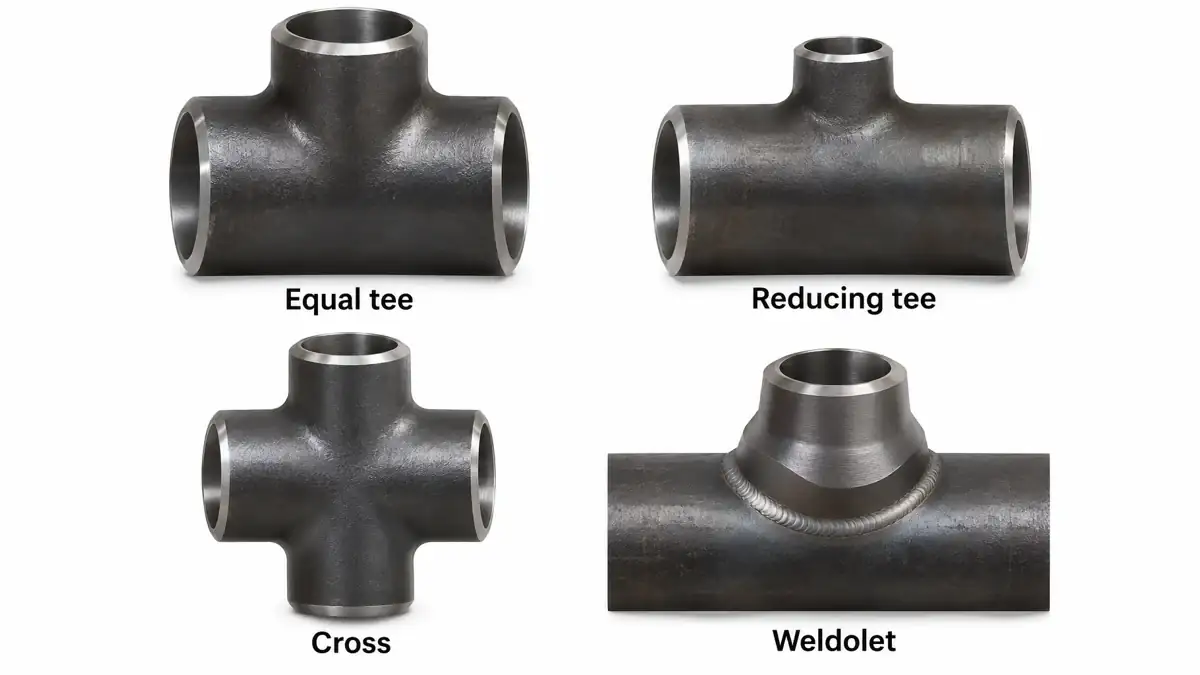
Tees, Crosses and Olets
An equal tee has a branch the same size as the run; a reducing tee has a smaller branch. A cross adds a fourth opening, but is used far less in process piping. When the branch is much smaller than the run, an olet is welded straight onto the run pipe instead of cutting in a tee. Olets are integrally reinforced, so no separate reinforcing pad is needed, and are covered by MSS SP-97: weldolets for butt weld branches, sockolets for socket weld and threadolets for threaded instrument connections (Project Materials). The project's branch table in the line class says which to use for each run and branch size. Olets get a full guide of their own soon.
Reducers (Concentric and Eccentric)
A concentric reducer keeps both ends on the same centreline. An eccentric reducer has one flat side, so the top or bottom of the pipe stays level. At a pump suction, reducers can trap air or vapour, so an eccentric reducer is installed flat side up to eliminate air pockets. When the supply source is above the pump, it is installed flat side down instead (The Process Piping).
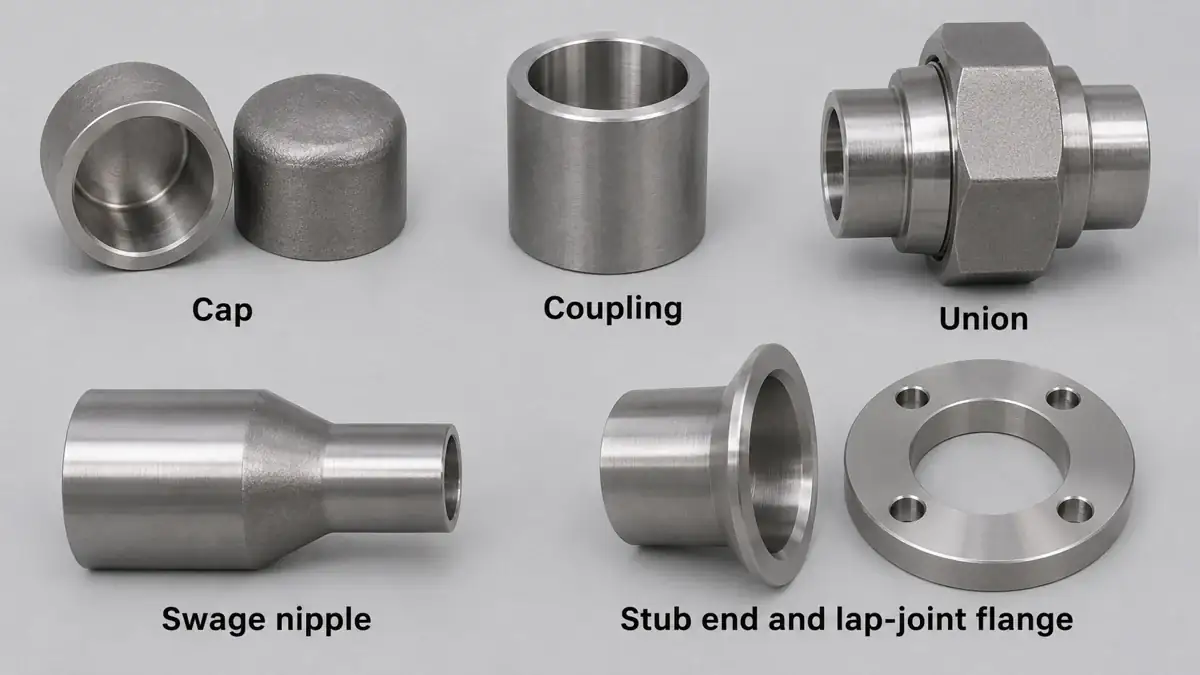
Caps, Couplings, Unions, Swage Nipples and Stub Ends
Butt Weld Fittings (ASME B16.9)
B16.9 covers the dimensions, tolerances, testing and marking of elbows, tees, crosses, reducers, caps and lap joint stub ends (Project Materials). Fittings are ordered to match the connecting pipe schedule, so a SCH 80 line uses SCH 80 fittings.
They suit larger and high-pressure lines because the full-penetration butt weld gives a smooth bore and can be radiographed. Materials come from separate ASTM specifications.
Socket Weld and Threaded Fittings (ASME B16.11)
B16.11 fittings are forged and rated by pressure class rather than by schedule (Project Materials). In hydrocarbon piping, socket weld is the usual choice up to about NPS 1-1/2 to 2, threaded joints are generally limited to utility service, and socket weld joints cannot be radiographed (Project Materials, B16.11 vs B16.9).
| Fitting class | Socket weld | Threaded |
|---|---|---|
| 2000 | Not listed | Sch 80 / XS |
| 3000 | Sch 80 / XS | Sch 160 |
| 6000 | Sch 160 | XXS |
| 9000 | XXS | Not listed |
Source: ASME B16.11-2021, Table 2.1.1-1. These correlations are the basis for calculating ratings; they do not specify the pipe wall to use for every installation.
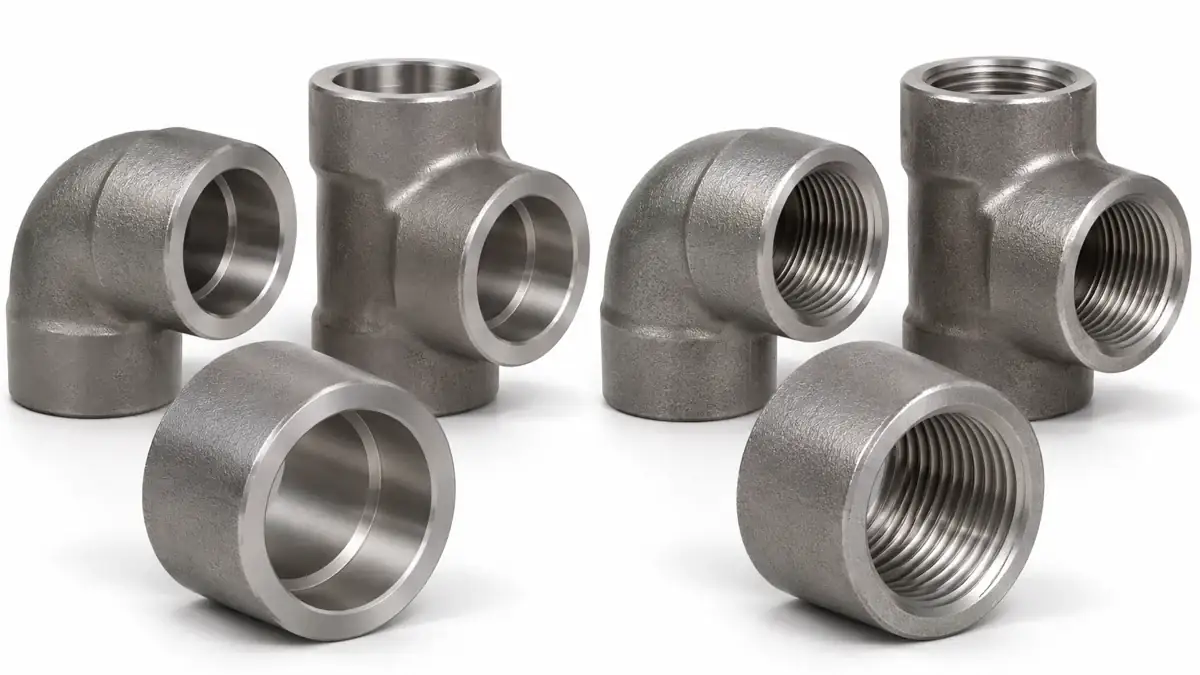
Pipe Fittings Selection Table
| Fitting | Function | End connection | Standard | Typical size range | Typical service |
|---|---|---|---|---|---|
| Elbow | Change direction | BW / SW / THD | B16.9 / B16.11 | NPS 1/2 to 48 (BW); 1/8 to 4 (SW, THD) | All lines; LR by default |
| Tee | Branch at 90° | BW / SW / THD | B16.9 / B16.11 | As elbows | Branches close to run size |
| Reducer | Change size | BW | B16.9 | NPS 1/2 to 48 | Eccentric at pump suction; concentric elsewhere |
| Cap | Close a line end | BW / SW / THD | B16.9 / B16.11 | As elbows | Dead ends, headers |
| Coupling | Join or branch small bore | SW / THD | B16.11 | NPS 1/8 to 4 | Small-bore lines, vents, drains |
| Union | Removable joint | SW / THD | B16.11 | NPS 1/8 to 4 | Small utility lines needing disassembly |
| Cross | Four-way branch | BW / SW / THD | B16.9 / B16.11 | As elbows | Rare in process piping |
| Swage nipple | Change size, small bore | Plain, bevel or threaded ends | MSS SP-95 | NPS 1/8 to 4 | Small-bore size changes, instrument hook-ups |
| Olet | Small branch off a run | BW / SW / THD (branch) | MSS SP-97 | Run NPS 1/2 to 36+ | Instrument, vent, drain and small process branches |
| Stub end | Carries a lap joint flange | BW | B16.9 | NPS 1/2 to 48 | Stainless and alloy lines |
BW = butt weld, SW = socket weld, THD = threaded. Sizes from Project Materials (B16.9, B16.11, MSS SP-95 and SP-97). The line class sets the actual limits on each project.
Pipe Fitting Materials and Gulf Project Use
| Material | Butt weld (wrought) | Socket weld / threaded (forged) | Typical service |
|---|---|---|---|
| Carbon steel | ASTM A234 WPB | ASTM A105 | General process piping, ambient up to about 400 °C |
| Low-temperature carbon steel | ASTM A420 WPL6 (impact tested at −46 °C) | ASTM A350 LF2 | LPG, LNG, ammonia, cold service |
| Stainless steel | ASTM A403 (e.g. WP304, WP316) | ASTM A182 F304 / F316 | Corrosive, hygienic and cryogenic service |
| Alloy steel | ASTM A234 (e.g. WP11, WP22) | ASTM A182 F11 / F22 | High-temperature steam and hydrocarbon |
| Duplex / super duplex | ASTM A815 (S31803, S32205 / S32750, S32760) | ASTM A182 (duplex grades) | Seawater, offshore, desalination |
Grades and services from Project Materials (B16.9, B16.11, A420 WPL6 vs A234 WPB, ASTM A815). See our materials selection page for how a grade is chosen.
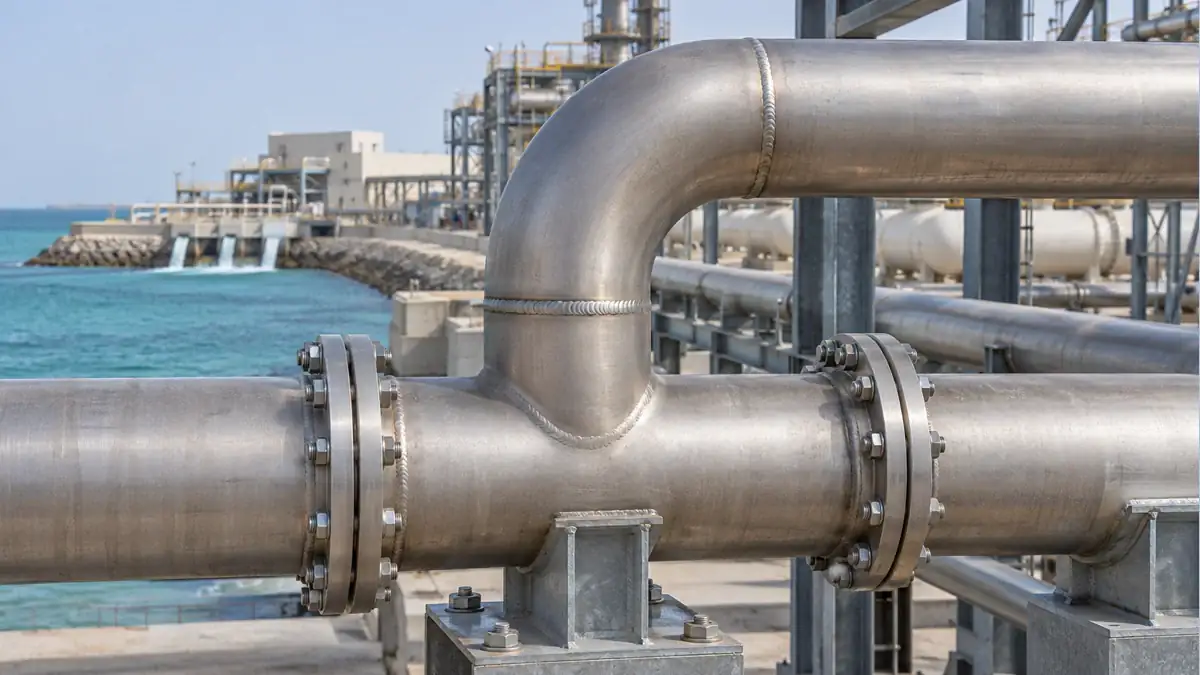
The GCC produces around 40% of the world's desalinated water (Oman Observer, February 2020). Desalination, seawater cooling and offshore platforms all need fittings that resist chloride pitting, which is why duplex and super duplex fittings are common on Gulf projects.
Duplex grades have a PREN of around 34 to 35; super duplex grades are near 42, and are used for seawater injection, offshore process piping, subsea lines and high-pressure reverse osmosis feed piping (Project Materials). Super duplex fittings are often made to order, so lead time matters when you plan procurement.
Read Isometrics and MTOs with Confidence
Augmintech's PG Program in Piping Design & Analysis covers piping components, codes and line classes, then isometrics and BOM generation in AutoCAD Plant 3D, across 150+ live hours over 6 months, with SP3D, CAESAR II, 3 industry projects and 500+ interview questions. ₹65,000 + GST in India, $850 abroad.
Frequently Asked Questions
Sources
- Project Materials: What is ASME B16.9; What is ASME B16.11; B16.11 vs B16.9; Long vs short radius elbow; MSS SP-97 vs SP-95; A420 WPL6 vs A234 WPB; ASTM A815.
- The Process Piping, "Pumps Suction Piping: Eccentric Reducers and Straight Lengths", theprocesspiping.com.
- Oman Observer, "GCC states account for 40pc of global water desalination capacity", 24 February 2020, omanobserver.om.
- ASME B16.9 and B16.11; MSS SP-95 and SP-97. Check current editions before design use.
This article was last reviewed on 4 November 2026.
