A fire fighting system detects, controls and puts out fires in a building using water, gas or chemical agents. It ranges from a fire extinguisher on a wall to a pumped network of hydrants, risers and sprinklers.
This page is the overview. Each main system has its own detailed guide, listed below. If you are an MEP or BIM engineer, this is the map of what the fire services contractor will put in your ceilings, shafts and plant rooms.
TL;DR
- A fire fighting system detects, controls and extinguishes fires with water, gas or chemical agents.
- Active protection fights the fire; passive protection contains it with fire-rated walls, doors and dampers.
- Seven systems cover most buildings: hydrants, sprinklers, wet risers, dry risers, hose reels, extinguishers and gas suppression.
- Water systems share one backbone: a fire water tank, fire pumps, a ring main, alarm valves and a fire brigade inlet.
- India follows NBC Part 4 and IS standards; the UAE and Saudi Arabia follow their fire codes, which lean on NFPA standards.
- In BIM, fire services are modelled in Revit as fire protection piping systems and coordinated with HVAC, plumbing and electrical.
What Is a Fire Fighting System?
A fire fighting system in a building is the set of equipment that does three jobs:
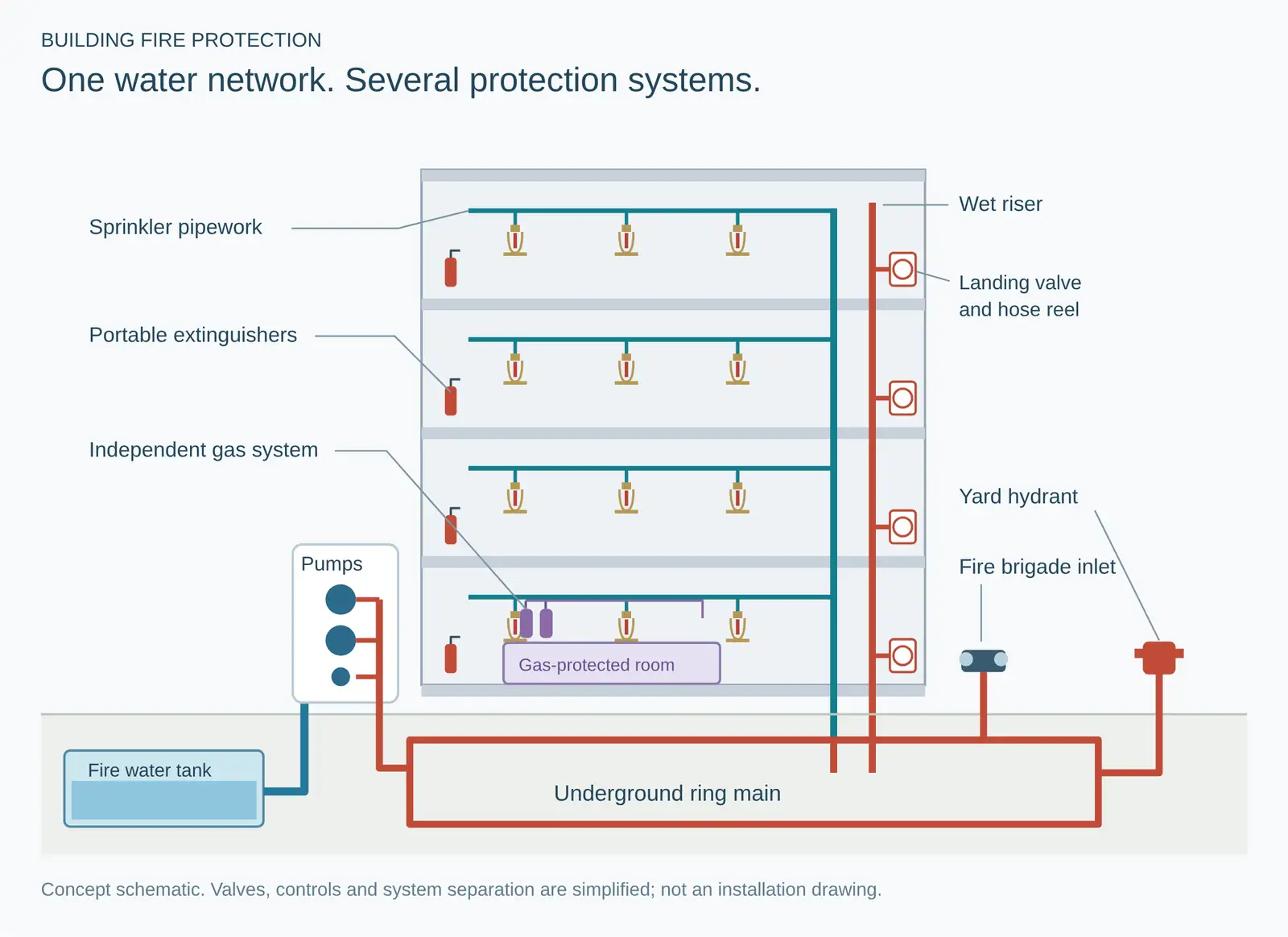
On a project, this is the "F" in MEPF, and it is designed by a fire protection engineer and coordinated with the other MEP services.
Active vs Passive Fire Protection
Definitions and examples from Cheshire Fire and Rescue Service; fire and smoke dampers as passive protection from InPro. A building needs both: active systems to fight the fire, passive ones to buy time for escape.
7 Types of Fire Fighting Systems
| System | Agent | Operated by | Typical use | Key standard |
|---|---|---|---|---|
| Hydrant system | Water | Firefighters | Around and inside larger buildings and sites | IS 13039, NBC Part 4; NFPA 24 |
| Sprinkler system | Water | Automatic | Most high-rise, commercial and industrial buildings | IS 15105; NFPA 13 |
| Wet riser | Water (always charged) | Firefighters | Taller buildings, outlet on every floor | IS 3844; NFPA 14 |
| Dry riser | Water pumped in by the fire brigade | Firefighters | Mid-height buildings where codes allow | BS 9990 (UK); local codes |
| Hose reel | Water | Occupants | First-aid fire fighting on each floor | IS 3844, IS 884 |
| Fire extinguishers | Water, foam, powder, CO₂, clean agent | Occupants | Every building, for small fires | IS 2190; NFPA 10 |
| Gas suppression | Clean agent or CO₂ | Automatic | Server, electrical and archive rooms | NFPA 2001; NFPA 12 (CO₂) |
Model and Coordinate Fire Services in Revit
Augmintech's PG Program in BIM MEP covers MEP system modelling, including fire protection, with clash detection, schedules and BOQs on three building projects, across 150+ live hours over 6 months, with recordings for 1000 days and 500+ interview questions. ₹1,50,000 + GST in India, $1,800 abroad.
Fire hydrant system
A pumped network of pressurised pipes feeding landing valves and yard hydrants, so firefighters can connect hoses anywhere around and inside the building. Indian codes call for at least 3.5 kg/cm² at the hydraulically most remote hydrant (IS 13039).
Sprinkler system
Pipes with heat-sensitive heads that open one by one over a fire. Comes in wet, dry, pre-action and deluge types, designed in India to IS 15105 and in the Gulf largely to NFPA 13.
Wet riser
A vertical pipe kept full of water, with automatic pumps and stored water behind it, and a landing valve on each floor (BAFSA).
Dry riser
An empty vertical pipe that the fire brigade fills from its tender through an inlet on the outside wall. In UK guidance, dry or wet risers may be used between 18 m and 50 m, and only wet risers above 50 m (BAFSA).
Hose reel
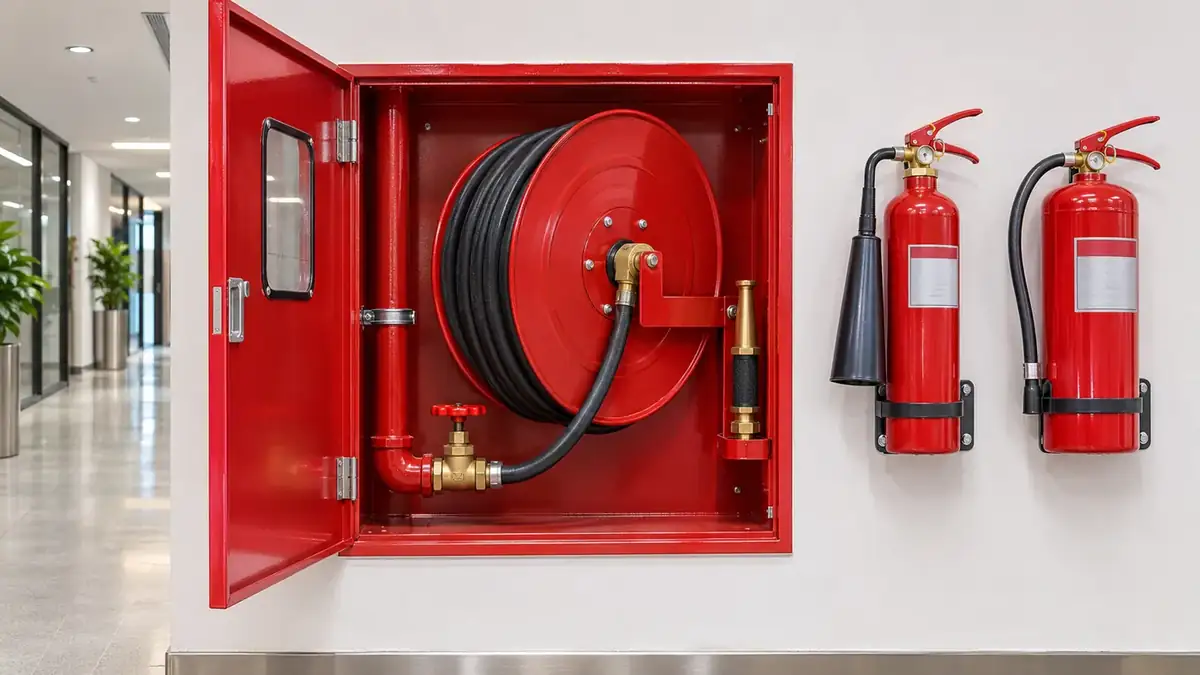
A permanently charged rubber hose on a drum next to the landing valve, for occupants to tackle a fire early. IS 3844 covers internal hydrants and hose reels.
Fire extinguishers
Portable first-aid equipment chosen by fire class: A (solids), B (flammable liquids), C (gases) and D (metals). IS 2190:2010 covers selection, installation and maintenance; for energised electrical equipment it allows only dry powder, CO₂ or clean agent types (IS 2190 text).
Gas suppression
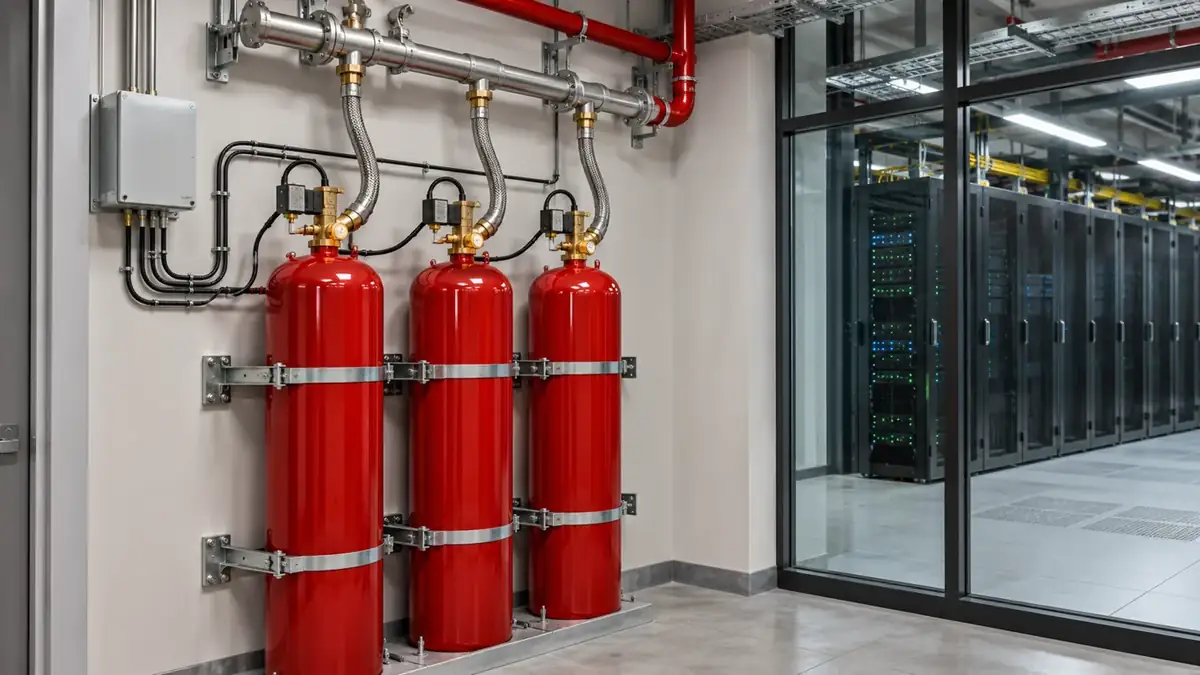
A total flooding system that fills a closed room with a gas agent, used where water would cause damage, such as data processing, telecom and art storage. Clean agents include HFC-227ea (FM-200), FK-5-1-12 (Novec 1230) and inert gases IG-541 and IG-55, under NFPA 2001 (Consulting-Specifying Engineer).
Main Components: Tanks, Pumps, Pipes and Valves
Hydrants, risers and sprinklers usually share one water backbone:
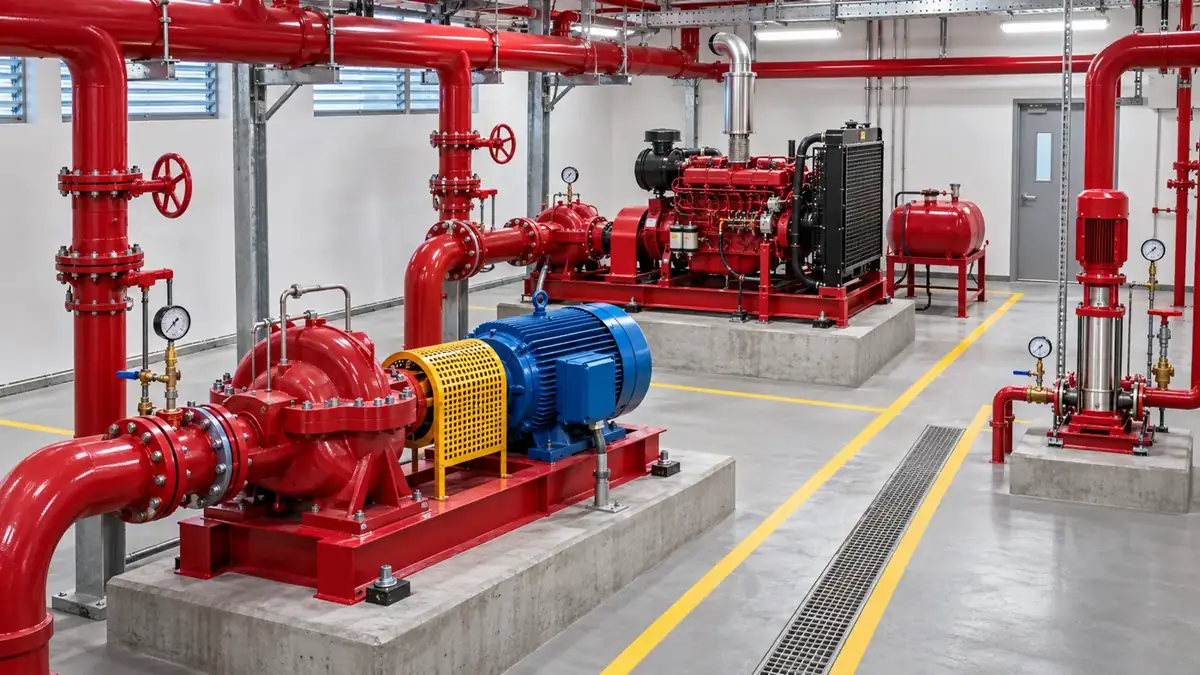
The pumps are the heart of the system: when pressure drops, the main pump starts, and the diesel pump takes over if power fails. They get their own detailed guide. Full guide: Fire pump (coming soon)
Fire Codes: NBC India, UAE and Saudi Arabia
India: NBC 2016 Part 4
- Part 4, Fire and Life Safety; Table 7 sets the systems, tanks and pumps needed by occupancy and height
- Design and equipment to IS standards: IS 13039 (hydrants), IS 15105 (sprinklers), IS 3844 (internal hydrants and hose reels), IS 2190 (extinguishers)
- Approved by state fire services
UAE: Fire and Life Safety Code
- UAE Fire and Life Safety Code of Practice (2018 edition), enforced by each emirate's Civil Defence
- Hydrants to NFPA 24, pumps to NFPA 20, sprinklers widely to NFPA 13
- Abu Dhabi issued 54 local amendments on 12 March 2026
Saudi Arabia: SBC 801
- Saudi Fire Code (2018), based on the 2015 International Fire Code with NFPA standards
- Section 903 sprinklers, 905 standpipes, 912 fire department connections, 913 fire pumps; Section 507 and Appendix C for water supplies and hydrants
- Standpipes to NFPA 14
India. NBC 2016 Part 4 Table 7 sets the minimum fire fighting installations for each occupancy and height (Table 7, Kerala Fire and Rescue Services copy), and Delhi Fire Service requires sprinkler design to IS 15105 with plans and calculations submitted with the building plans (Delhi Fire Service).
UAE. The UAE Fire and Life Safety Code of Practice governs fire systems, enforced by Civil Defence in each emirate. Hydrant systems follow the code with NFPA 24 and pumps follow NFPA 20 (MMJ), and NFPA 13 is widely adopted for sprinklers (BITO). Abu Dhabi Civil Defence released 54 amendments on 12 March 2026 covering items including fire pumps and hydrants (Vortex Fire).
Saudi Arabia. SBC 801 is based on the 2015 International Fire Code and NFPA standards, revised in 2018 (Pillai, ASRJETS 2025). Its fire protection chapter covers sprinklers (903), standpipes (905), fire department connections (912) and fire pumps (913) (SBC 801 contents).
The NFPA standards that come up most on Gulf fire projects:
How Fire Fighting Systems Are Modelled in Revit
In a BIM project, fire services are modelled in Revit alongside the other MEP systems:
- Fire protection piping systems: Revit has system classifications for wet, dry, pre-action and other (user-defined) fire protection systems (Revit API reference).
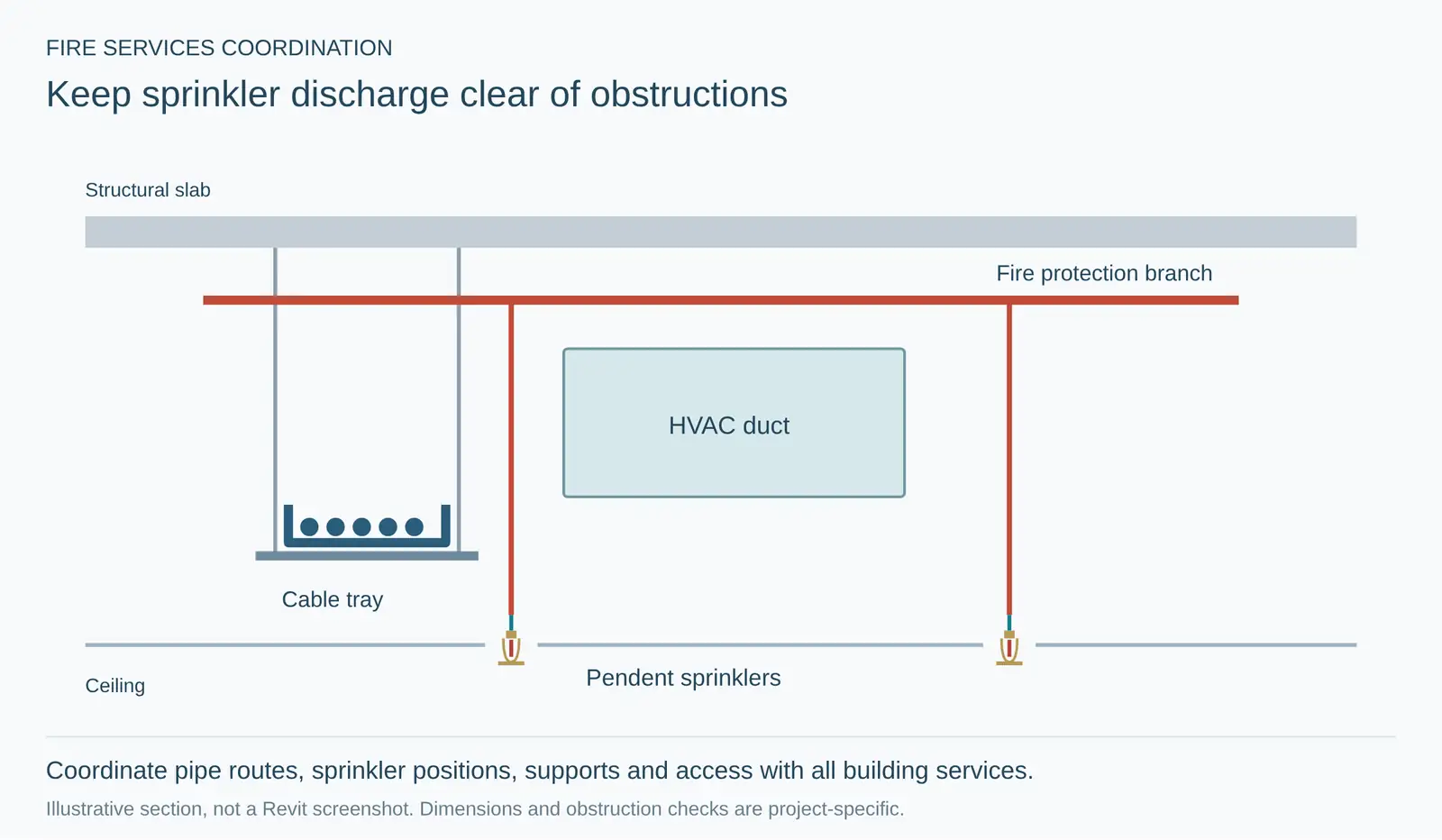
- Sprinkler and equipment families: place pendent, upright and sidewall sprinkler families, landing valves, hose reels, pumps and valves, then connect the piping.
- Clash coordination: run Collaborate › Coordinate › Interference Check between fire pipes and ducts, cable trays and structure; the report lists every conflicting pair (Autodesk Help).
- Penetrations: mark where pipes cross fire-rated walls, so fire stopping is planned, not improvised on site.
Hydraulic calculations for sprinklers and hydrants are usually done in dedicated fire protection software, with Revit carrying the coordinated model, drawings and quantities.
Frequently Asked Questions
Sources
- Cheshire Fire and Rescue Service, Active and passive fire protection; InPro, Active vs passive fire protection.
- BAFSA, Wet and dry risers (BIF 21).
- Bureau of Indian Standards, IS 2190:2010; NBC 2016 Part 4 Table 7 via Kerala Fire and Rescue Services; Delhi Fire Service FAQ; NBCS 2026 via Drishti IAS and ULBA.
- Consulting-Specifying Engineer, Forssell, Hill and Kramer (2018), Selecting the correct clean agent suppression system.
- UAE: MMJ; BITO; Vortex Fire (ADCDA amendments, March 2026).
- Saudi Arabia: SBC 801 (2018) contents; Pillai (2025), ASRJETS.
- Autodesk: Revit system classifications; Interference Check.
This article was last reviewed on 7 November 2026.
